
Back To Basics: Simple Breads To Make Now
If you’ve always wanted to make your own bread – or if you’re looking for the best, simple breads to make – these are the recipes for you! You will see how easy it really can be to make bread and, most importantly, you’ll have success.

Can bread really be simple? Can whole wheat breads really be soft and delicious? Why talk about making bread anyway when it’s so easy to buy?
If you’ve ever asked these questions then I’m happy to have answers for you:
- Yes, after years of experimenting I can definitely say that good homemade bread can be simple to make.
- Yes, there are recipes that result in 100% whole wheat bread that is so good you will be proud to share it with everyone.
- For centuries bread has been the staff of life. There’s something so elemental and grounding about baking bread to serve your family. Plus fresh bread out of the oven can never compare to store bought.
What are the basic ingredients of bread?
The ingredients for most breads are simple and usually few – water, flour, yeast, and salt. This makes homemade bread super cheap (think about that the next time you pay $5+ for one loaf…).
What are the basic steps to making bread?
With yeast breads, most of the time it takes is just waiting for the rise(s). The hands-on time is pretty minimal (especially if you have a mixer to knead the dough if it’s called for). The basic steps are:
- Mix the ingredients.
- Knead – by hand or by machine.
- First rise in a bowl.
- Punch down and shape.
- Second rise in pan.
- Bake and cool.
And the result? When you bite into a piece of bread you have made for the first time, you will feel like you can do anything!
But we all start out a bit scared by the thought of making bread.
I totally know that the thought of making bread scares many people because I used to be scared, too. What if it didn’t rise? What if it tasted odd? What if it looked weird?
I’ve also read a lot of recipes for breads that involve way more time, effort, and know-how than I ever want to put in the kitchen.
But I’m here to say that you CAN make breads successfully!! Maybe not every complicated bread out there (croissants, anyone?), but you can have a handful of go-to bread recipes that taste amazing, save you money, and free you from store bought bread.
My motto here at An Oregon Cottage has always been: simple, frugal, and fun – that’s how you have a simple homemade life in the kitchen, in my experience. The following three simple bread recipes all fall under these guidelines.
Simple Breads Anyone Can Make
I’ve listed the three bread recipes in order from easiest to only slightly less easy (ha), which means we’ll start out with a baking powder recipe and then move on to easy yeast doughs.
All of the recipes fit one category or another, so with them you will be able to make sandwiches, serve with a soup, and make biscuits and gravy, just to name a few!
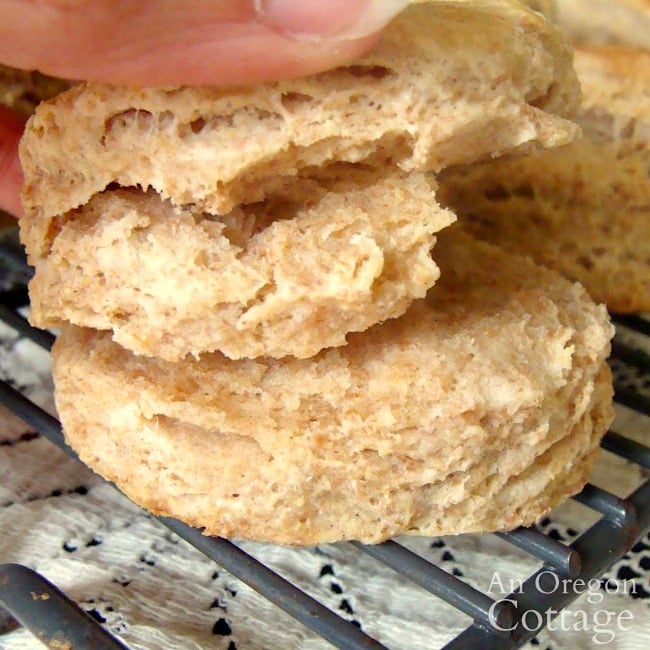
Start with: Whole Wheat Baking Powder Biscuits
For a quick win, make this fast-to-make bread to go with soups and stews, to serve as a base for breakfast sausage-and-egg sandwiches, or make ham or turkey “slider” sandwiches.
This recipe for amazing whole wheat flaky biscuits is hands-down my favorite and I’ve got a step-by-step picture tutorial for you to follow that takes all the guesswork out of it.
Bottom line: Control of ingredients at a cost of less than $1.50 for the whole batch.

Dip your toes into the world of yeast with: Easy Artisan Bread
This is hands-down the easiest yeast recipe I’ve ever made and it turns out wonderful every time with no kneading and hardly any hands-on time.
Easy Artisan Bread is made in an enameled cast iron dutch oven to replicate that famous artisan-type crust. Your family and friends will think you are an amazing bread maker when you serve them this – and you are well on your way to being one!
Bottom line: feeling of super-hero power with the first bite at a cost of about .50 versus a $4 to $5 store bought loaf.

Finally, make the 100% whole wheat soft sandwich bread you thought you never could with: Easy Whole Wheat Sandwich Bread
This is it guys- when you make this bread you won’t need to ever buy a loaf of bread from the store again (if you choose not to…). What a great feeling!
If someone had told me a few years ago that I wouldn’t be buying bread anymore I would’ve laughed at them (with visions of some of my previous “leaden” loaf attempts running through my head…). But I’m here to say it’s doable. Really. So make it your goal to try it and see if you like it.
Bottom line: Ma Ingalls feeding her family at a cost of about .70 cents a loaf.
Bread Making Q & A
What flour is best for bread making?
While you can use all-purpose flour for a white bread, you’ll get the added health benefits and fiber from whole wheat flours. And a flour with a higher protein content will produce lots of gluten which helps your bread to rise.
The biggest confusion for people, I think, when using whole wheat flours is the difference between whole wheat flour and whole wheat pastry flour. Here’s what you need to know:
- The protein content in flours is what makes them different and best for different kinds of breads.
- You want more protein to help develop gluten in yeast and sourdough breads which you’ll find in hard wheat varieties.
- You want less protein in fast rising recipes like biscuits that use baking soda and/or powder for rising.
Whole wheat flour is typically made from hard red wheat, a wheat higher in protein (14%) than all-purpose and pastry.
Whole wheat white flour is made from hard white wheat, with a lighter texture but still high in protein content (12-13%).
Note: bread flour also has a high protein content (12-13%) and is most often made from a hard spring wheat. It’s most often a white flour, though, and harder to find in a whole wheat version.
Whole wheat pastry flour is made from soft white wheat with a lower protein content (8-9%), making it great for cookies, cakes, quick breads, muffins and the like. I found I can substitute this 1:1 for white flour in these recipes.
As a comparison, all purpose flour has a 9-12% protein content, which is why it works for both bread and cookies, but of course has many of the nutrients stripped out in processing.
How do I know I’ve kneaded enough?
If your dough springs back immediately when lightly pressed and doesn’t tear when you pull it, it’s been kneaded enough and is ready to rise. If not, knead for 1-2 minutes longer or until you get this result.
How long does homemade bread last?
Store bread in an airtight container or bag for 2-3 days at room temperature. For longer storage, slice, bag, and freeze for 2-4 months. The refrigerator causes bread to go stale, so isn’t a preferred storage.
Ready for more simple bread recipes?

Tutorial: Simple French Baguettes Recipe – The Bread You Can’t Stop Eating

Quick & Tender Homemade Hamburger Buns {or Breadsticks}
Or try your hand at making sourdough!

How To Grow, Keep, & Use A Sourdough Starter
Easy Sourdough Artisan Bread Recipe
Easy Homemade Whole Wheat Sourdough English Muffins
And you can see all my simple breads here: Best Bread Recipes.

This article has been updated – it was originally published in July of 2010.


I linked back to you from this post
Missie- Whoo-hoo! Success- now on to pitas. 😉
Jami, I made your biscuit recipe tonight to go along with my cowboy meatloaf. They were a hit! I used 2c whole wheat pastry flour and 1c unbleached all purpose flour. My husband said that these biscuits were “better than any you could go buy in a restaurant!” High praise indeed, my friend. Thanks for posting the recipes and how-tos to go along with them. That helps immensely!
Now off to try your pita bread later in the week!