
Easy Canned Pizza Sauce Recipe With Frozen or Fresh Tomatoes
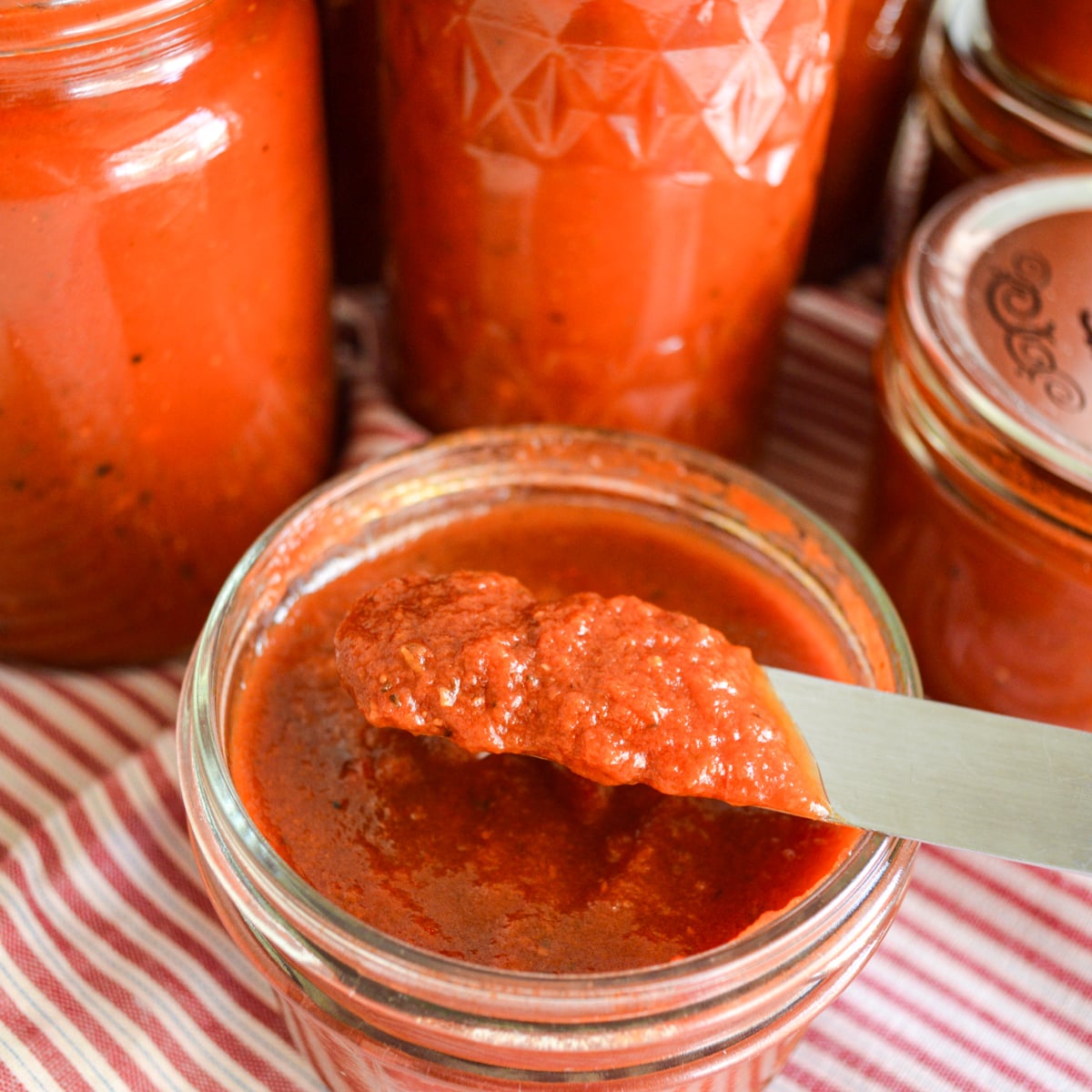
Ever wondered how to make delicious pizza sauce from scratch with either fresh or frozen tomatoes? Here’s a simple, easy to follow canned pizza sauce recipe with detailed steps and tips to make the perfect sauce right in your kitchen to water-bath can or freeze. The biggest tip of all? Using frozen tomatoes to reduce cooking time and to be able to make it when you want! Say goodbye to store bought cans and hello to your new go-to homemade recipe for your next pizza night.
✩ What readers are saying…
“This is the best…..the method and the recipe!!! I am so excited to have my own pizza sauce…It is so thick and beautiful.” -Yvonne

Some links in this article are affiliate links and if you click on them I will receive a small commission at no cost to you.
This wonderfully seasoned canned pizza sauce forms the MVP’s of my canning recipes together with my favorite salsa, roasted tomato sauce, and addictive tomato chutney.
So during the tomato harvest I make enough of these four staples to see us through the year and I only make other things like bruschetta topping or rotel if I have any tomatoes left. It’s part of how I make sure we have enough of what we use the most so that I never have to buy them at the store.
However, for a number of reasons (time issues, weird tomato season, other commitments), one year I just couldn’t find the time to make all our tomato recipes when the tomatoes were coming in fast and furious. Since I had a few cans of pizza sauce left on the shelf I concentrated on the other tomato recipes and simply froze enough bags of paste tomatoes (with a few heirlooms thrown in for great flavor) to be able to make the pizza sauce later.
In January I pulled out the frozen tomatoes and made the easiest, best pizza sauce ever that was done in record time! Since then I’ve frozen our tomatoes at least a day or two before making sauce, even during canning season, because less cooking time is a good thing!
While you can, of course, make this sauce from fresh tomatoes – and I give directions for both – frozen is my preferred way now since it makes the cooking down part go so much quicker. Read on for all the details, including answers to lots of questions after the recipe card!
Recipe Ingredients
Besides tomatoes you’ll need the following ingredients:

Ingredient Notes
- Oil: I prefer olive oil as it’s traditional in Italian style sauces, but you can use avocado oil or an oil of your choice. And yes, it’s safe to use this small amount of oil in a canned recipe – see note below.
- Fresh onions and garlic: To keep this recipes safe for canning you MUST stick to the amounts of fresh ingredients that are listed in the recipe card. DO NOT add more garlic, onions, or fresh herbs.
- Salt: You can use canning salt or pure sea salt – you want a salt with no additives like table salt has.
Origin and Safety of this Canned Pizza Sauce Recipe
This recipe is based on the Ball Blue Book’s Seasoned Tomato Sauce, cut in half and with different dry spices to make it a pizza sauce. (It’s in this most recent version of the Blue Book on page 33.) It’s a tested recipe that safely uses the fresh onions and garlic called for as well as the oil. Feel free to use less if you’d like but you cannot use more if you want to can it to be shelf stable (you can use as many fresh things as you’d like if you’re freezing the sauce).
Canned Pizza Sauce Recipe: Step-by-Step
Detailed quantities and instructions are included in the full recipe box below, but here are a few extra tips to help with each step:

Step 1: Thaw (if needed), Puree and Strain Tomatoes
To Use Frozen Tomatoes
- Thaw tomatoes (overnight is good) in a bowl or the sink (in case the bags leak). (Reader Tip: “To thaw, we fill (half way) a CLEAN SINK with hot tap water, then dump a half bag (at a time) of the frozen tomatoes into the hot water for a few moments, and the peels slide off easily. Then we continue with the thawing process. It saves a lot of time and ware & tear on the machine.”)
- Drain the accumulated clear juices- open one corner of the baggie and pour off the juice.
- Run through a food mill to remove the seeds and skins.
To Use Fresh Tomatoes
- Wash, core, and halve tomatoes.
- Bring to a boil in a large stock pot. Remove from heat. (Reader Tip: “My new lazy way to start these recipes is to roast the tomatoes, its easier/faster than stovetop and goes through the processor easily. Simply wash, cut in half, cut the stem out and roast at 350 for around 20-40 minutes, depending on how many you’re roasting.”)
- Strain skin and seeds through a food mill.
Three Ways to Strain Tomatoes for Sauce

- Victorio Food Strainer and Sauce Maker (above top left). To me this maker is like the little girl with the curl: when it’s good, it’s very very good and when it’s bad…well, you know. Even though I’ve read you don’t need to heat the thawed frozen tomatoes, this food mill just didn’t want to work with them until I heated them a bit.
- Tripod/Cone Food Mill (Chinois): I ended up reverting back to my vintage metal tripod food mill (which you can still buy new – I guess some designs have staying power!) for some of the cold pulp, but it takes more elbow grease and doesn’t result in as much usable pulp as the Victorio.
- Electric Sauce Maker: This may be the easiest way to get tomato sauce ever! Shown above on the bottom is the FreshTech Harvest Pro Sauce Maker which is sadly not made anymore (see below for available substitutes). I’ve used this with both fresh tomatoes as well as frozen tomatoes and it works fabulously with both. I had sauce in no time without needing to bother with heating in any form. I truly do love using a machine – it really makes this easy (as well as other sauces like applesauce).
Since I use the electric sauce maker multiple times in a growing season for tomato products and apples because it saves so much time and effort, I’ve rounded up a couple options for you to check out since the one I use is no longer made:
- Weston Deluxe Electric Tomato Strainer, Food Mill, Sauce Maker
- VEVOR Electric Tomato Strainer, 400W Tomato Sauce Maker Machine (half price of the one above)
- KitchenAid KSMFVSP Fruit and Vegetable Attachment Strainer (most inexpensive option if you have a KitchenAid)
TIP: Idea for using up all the pulp from straining:

Spread all the pulp as thinly as you can on parchment-lined trays in a dehydrator and dry at 135 until it’s crisp and completely dry all the way through (this will take hours – the exact amount depends on your machine and humidity).
Once completely dry, break off pieces into a blender or food processor and whir until it’s even crumbles. Keep on the shelf in a mason jar and add to anything you’d like to thicken or flavor – soups, chili, and sauces!


Step 2: Make Pizza Sauce
- Sauté onion and garlic in olive oil for a few minutes and then add the tomato puree and all the seasonings. Bring to a boil, reduce heat and then simmer 30 minutes.


- Blend the sauce to make it smooth (yes, you’ll appreciate the smooth sauce on the pizza). You can carefully transfer batches to a blender or you can do what I do – use an immersion hand-held blender right in the pot.
- Bring back to a boil, then reduce the heat to simmer the sauce on low until it thickens to your desired consistency. This will take 1-2 hours, depending on if you started with frozen tomatoes (less time) or fresh (more time). It also will depend on how juicy the tomatoes were you started with – paste tomatoes take less time, slicing are juicier and will take longer.
TIP: Sauce taking longer to thicken? I’ve gotten questions similar to this: “My sauce did not thicken after two hours of simmering (used fresh tomatoes) – why?”
Answer: Your tomatoes were probably juicier, which happens a lot with fresh tomatoes if you’re not pouring off juice from frozen tomatoes first. Also it depends on the type of tomato – slicing/heirloom tomatoes are much juicier than paste tomatoes. Just keep simmering! (This is why I like starting with frozen tomatoes so much!)

Step 3: Water Bath Can the Sauce (or Freeze)
Note: You can always freeze the sauce – let it cool and transfer to freezer safe containers for up to a year – but for the most convenience, can the pizza sauce to be shelf stable.
- Add lemon juice or citric acid to each jar, fill jar with 1/2-inch headspace, wipe rims, and attach lids. Do one jar at a time, adding each to the rack of a water bath canner before filling the next jar.
- Process both pints and half-pints for 35 minutes in a boiling-water canner.
- Remove to a towel-lined surface and let sit undisturbed for 24 hours.
TIP: I’ve found that both half-pint 8-ounce or 12-ounce jars are good sizes for medium-to-large pizzas. The 12-oz. jars are actually the perfect size but they’re harder to find, so use what you have (whole pints are too much, which causes the dough to not cook fully in the center, unless you regularly make 2 pizzas at a time).
If you’re new to canning this tutorial will take you through each step. You can also watch all the easy steps to water-bath canning in this video:
How much pizza sauce to make for a year?
We make this easy homemade pizza dough a couple times each month (every other Saturday, like I outline in my menu planning tips), though sometimes we make the pizza with pesto instead of tomato sauce so I aim to have 20-24 jars on our shelves in varying sizes to last a year.
Oh, and this sauce is also good in any Italian recipe, so it finds its way into things other than pizza – a lot.
Reader Raves
“I just used your recipe earlier this week & I must say kudos and thanks to you! It used up all the tomatoes from my garden perfectly and your freezer method was fabulous as my tomatoes came ripe at different times…We cannot wait to dig into this! Thanks so much for the great recipe!” -Nicole
“This is an incredible recipe. We have our jars processing in the water bath now. There was a little bit of sauce left in the pot that we ate up with bread. This recipe will be used for the years to come. Yummy!!!” -Roberta
“Thank you for the great recipe! Mine is simmering down now and smells awesome…I’m new to this canning thing so I get a little nervous but your post really was great in explaining everything.” -Susan
“This was freakin fantastic. I started with a half batch and once I tasted I knew I’d have to do more. If I wasn’t so greedy, I’d share with friends but I might like my new pizza sauce more than I like them.” -Kat
I hope you love this canned pizza sauce recipe, too – if you make it, be sure to leave a recipe rating so I know how you liked it! (Have a question? Scroll down to see if I’ve answered it!)
Want to save this?
Enter your email below and you’ll get it straight to your inbox. Plus you’ll get easy new recipes, gardening tips & more every week!

Easy Canned Pizza Sauce Recipe With Frozen or Fresh Tomatoes
Equipment
- Sauce maker/food sieve
- 12-quart or large stock pot
- water bath canner and supplies if canning
- canning jars and lids if canning (freezer containers if freezing)
Ingredients
- 22 pounds tomatoes fresh or whole frozen
- 3 cups chopped onions
- 6 cloves garlic minced
- 1/4 cup olive oil
- 2 tablespoons dried basil
- 1 tablespoon dried oregano
- 1 tablespoon dried thyme
- 1/2-1 tablespoon black pepper, or to taste if you’re not as much a pepper fan as we are
- 1 tablespoon sugar or honey or to taste
- 2 tablespoons salt, canning salt or pure sea salt
- 1-2 teaspoons crushed red pepper flakes, to taste – use less if you're unsure or omit
- Bottled lemon juice or citric acid: 1 tablespoon lemon juice OR 1/4 teaspoon citric acid for EACH pint and 12-oz jars; 1/2 tablespoon lemon juice OR 1/8 teaspoon citric acid for EACH half-pint jars I usually use citric acid, as it doesn’t add more liquid to our sauce
Instructions
Prepare tomato puree from frozen tomatoes:
- (Assuming they were cleaned and cored before freezing) leave to thaw 24 hours; drain accumulated juices.
- Put the thawed tomatoes through a strainer to remove seeds and peels.
Prepare tomato puree from fresh tomatoes:
- Wash, core and halve tomatoes. Heat to boiling and then remove from heat (TIP: I use a 12-quart stockpot and a 6-quart soup pot for 22 pounds).
- Put through a strainer while warm to remove seeds and peels.
Make the pizza sauce:
- In a 12-quart or larger stockpot cook onions and garlic in the olive oil over medium heat until the onion softens, 5-10 minutes. Add tomato puree and all the seasonings (basil through pepper flakes). Bring to a boil, reduce heat and cook for about 30 minutes, uncovered. Process with an immersion blender to make a smoother sauce (or carefully blend in batches).
- Bring back to a boil; reduce heat and simmer, uncovered, until sauce reaches desired consistency (reduced by 1/4 to 1/3), usually an hour or two, depending on if you started with fresh or frozen tomatoes (it may take longer – cook until desired consistency). Make sure to stir occasionally to prevent sticking (TIP: if you have a thin-bottomed stock-pot, stir more often to prevent scorching).
Water-Bath Can:
- Add the lemon juice or citric acid to each clean, warm jar, fill jar with sauce leaving 1/2-inch headspace and attach lids and rings until fingertip-tight. Place in canner rack and repeat with remaining jars to fill canner (keep sauce and jars warm, as you will need to do a couple canner loads when using half-pints-see how to water bath can here).
- Process both pints and half-pints for 35 minutes in a boiling-water canner.
- Remove to a towel-lined surface and let sit undisturbed for 24 hours before checking seals, labeling and storing in a cool, dark place.
Notes
Nutrition
Your Questions Answered
Yes, I do that all the time. Just keep all the measurements halved exactly.
No – fresh herbs are low acid and the recipe is based off the tested Ball canning recipe that uses only dried herbs so it would be a safety issue with the ratios of low-to high acid off.
Also for cooked and canned products like this, dried herbs hold their flavor better (some fresh herbs actually turn bitter when cooked and canned).
Nope, those are both low acid ingredients and will throw off the ratios for safely canning and storing on a shelf. You can do that and freeze the sauce, though.
The 22 pounds would be the total weight fresh or frozen before anything is removed or drained. (Fresh and frozen weight will be the same, but if you’re coring before freezing, then you’d want to weight beforehand and write the pounds on the outside of the baggie.)
I have only just read that this year (2024) and I have been doing pouring off the juice for many years, as have many canners like me. I learned it from a master canner and recently read of another who also pours off the juice to save time cooking, too. All that to say – I haven’t found any research on this as to the amount of acid that’s potentially being lost (all tomatoes vary in acidity anyway) AND we add citric acid to each jar. I will continue to pour off the juice from thawing and keep the jars on a shelf and am totally comfortable with that, but you obviously need to do what you are comfortable with.
No, adding any thickener like paste before processing will create a new density that hasn’t been tested. You can cook the sauce down longer, but not add anything else before processing.
You can use a small amount of oil to sauté vegetables – as the original, tested Ball Blue Book Seasoned Tomato Sauce recipe that this was based on does (found on page 33 of this most recent version). Here’s a seasoned sauce that is online and uses some olive oil.
Yes, as long as there are only tomatoes listed as the ingredients. A 14.5 ounce can equals about 1 pound of tomatoes, so you’d need 22 cans.
You can do two things: reprocess the jars (open them, add to a pot and bring to a boil again before canning again) or simply store the jars in the refrigerator (which is what I do – it happens to everyone!).
Yes, you can totally to that! I often do things like that to break up preserving tasks.
I can’t say exactly, because it depends on what kind of food mill you use (some get more pulp/puree from the tomatoes than others), but I’d estimate around 17-18 cups which should cook down to the 14-15 cups to get the 7-8 pint yield.
More Easy Canned Tomato Recipes
- Water-Bath Safe Canned Roasted Tomato Sauce
- Addictive Tomato Chutney
- Nice and Thick Salsa for Canning
This recipe has been updated – it was originally published in 2014.
Disclosure: affiliate links in this article will earn commission based on sales, but it doesn’t change your price. Click here to read our full disclaimer and advertising disclosure.

Hi, there! I just used your recipe earlier this week & I must say kudos and thanks to you! It used up all the tomatoes from my garden perfectly and your freezer method was fabulous as my tomatoes came ripe at different times. I don’t have a food mill so I just used a mesh strainer & pestle — which did the job perfectly — but, sadly, the strainer did not survive. Oh well! Perfect excuse to finally get myself a food mill! Anywho, I only got 3 pints as well from my batch but I suspect that’s because I had to leave my sauce simmering just a titch longer while I dashed off to work for a quick appointment. I left the hubby in charge and he could not stop exclaiming how much he loved the smell! We cannot wait to dig into this! Thanks so much for the great recipe!
Hello, this sauce has been simmering all day, and I just tasted it…all I taste to black pepper! No onions or garlic-just black pepper! I thought perhaps it was supposed to be a tsp, but I checked (3 times) and the recipe reads a Tbsp! Have you experienced this or heard from anyone else that has? If so, do you know how others countered the pepper? Thank you in advance!
Gee, I don’t notice that at all, Laura – I’m so sorry you do! We really like black pepper, though, so maybe that’s the difference? It’s what I do, but it’s certainly up to taste. I’ll go ahead and update the recipe to say ‘or to taste’ for others who may not like as much pepper in their foods. Again, I had no idea anyone wouldn’t like it like we do, so I really am sorry for your sauce right now. I’m hoping it will be okay for you on pizza, though, since there are other flavors going on, after all your work!
im having some difficulty getting the sauce thick. I cooked it or tWo hours last night and no luck I’m wondering if you have any advice?
Thank you for your time.
jody
It will take longer to thicken depending on how much juice your tomatoes had (paste-type is least, heirlooms more) – were you able to drain some from frozen tomatoes? If not, it will take longer – just keep cooking!
Hi Jami! Love your stuff…so…so much! We make tons of your recipes. Last year I made this pizza sauce and spent what felt like hours pushing the tomatoes thru my wire mesh strainer to remove seeds. I do not have a food mill/press. The pizza sauce came out amazing and we just finished the last jar 🙂 My family is asking for more. I wanted to ask your advice. Do you think it would work if I blanched the tomatoes, peeled, hand removed the seeds, and pureed the rest of the tomato? Thank you, again we love your ideas and recipes!
julie
Well, I’m a firm believer in doing what you need to do to make something work for you, Julie, so if that seems easier to you, go for it! The one thing with starting from frozen tomatoes (even just frozen for 24 hours) is that you can pour off a lot of the liquid when they thaw so your cooking time is lessened. So just be aware that you may need to cook it longer to get it thick. I’m glad your family likes it!!
Would it work if I put the ingredients in a crockpot instead of cooking it on the stove for 2 hours? I have done this with a different pizza sauce recipe and it reduces down just fine, I just never canned it afterwards. Thanks!
That should be fine, Monica – it wouldn’t affect the canning. I’ve had tomato sauce turn bitter for me in a slow cooker, so I don’t chance it anymore. 🙂
I don’t currently have the concentration or undivided attention necessary for canning (I have a two year old so I feel like I would get easily side tracked), so I would like to freeze this instead. Do I still need the citric acid for freezing? I’m guessing it’s function is to regulate the acidity for canning but I just wanted to clarify. Thanks!
Yes, that’s right, Megan – if you are freezing (which this will do great with!), you don’t need the acid.
Thus is an incredible recipe. We have our jars processing in the water bath now. There was a little bit of sauce left in the pot that we ate up with bread. This recipe will be used for the years to come. Yummy!!!
So glad you like it as much as we do, Roberta. 🙂
This looks great! I found a link to your post on Pinterest, and I’m going to include a link to the post in a Canning Recipe roundup that I’m doing on my blog today… hope you can stop by to see it! 🙂
Thank you, Heather – I will!
Hi. Could I use a pressure canner instead of water bath for this? Also, if I did would I still add the lemon juice to each pint and half pint? Thanks for the help and love the simplicity of this recipe!
Yes, Shaina, you can pressure can the sauce, though the Nat’l center for home food preservation says you still need to add the lemon juice or citric acid – http://nchfp.uga.edu/how/can_03/tomato_sauce.html
Enjoy your sauce 🙂
I have frozen my tomatoes to make this and other recipes. Should the 22 lbs of tomatoes be weighed after they are thawed, or when they are frozen? Obviously after they lose all the water in the thawing process it will take a lot more frozen tomatoes to make 22lbs…??
Oh, dear – you need to weigh them before freezing, Denise (at least that’s how I know to do it). I weighed them and wrote on the bag how much was in each. I’m not sure if they weigh more than that when frozen – does the freezing increase the weight? You’re right that after thawing wouldn’t be correct. Sorry I don’t know another way!
Does the 1/8 tsp citric acid go into the whole recipe or each jar? If into each jar do you mix it in or leave it at the bottom of the jar?
It goes into each jar, Katie and you don’t have to mix it in, it will be mixed as it cooks in the canner. I just add the citric acid right before I add the sauce and seal the jars with the lids.
Thank you for the great recipe! Mine is simmering down now and smells awesome. I used the food mill method and it got most of the seeds out pretty easily. I might run it through again just because I don’t like the look of them on my pizza. I went a little different route for my tomatoes. I threw my tomatoes in the oven to get the puree and it seemed to work OK. I was working on other things so it was easy to weigh out 11 lbs and chuck them in the oven until they were soft enough to run through the mill.
Because the mill did such a great job straining everything, I didn’t want to put in gobs of onions in there so after I did the saute part, I ran through the blender with a a couple of ladles of sauce and returned it to the big pot.
I realize when I make homemade how much our taste buds get acclimatised to store bought which is way sweeter. I am going to trust that when this is on yummy dough with fresh mozzarella and a ton of basil, the tomato goodness is going to shine right through.
I’m new to this canning thing so I get a little nervous but your post really was great in explaining everything.
So glad to know that the post was helpful, Susan! It is true about the sugar in store bought things – and not just tomato products! If you really do prefer it sweeter, you can add honey (or sugar) to taste – it’s safe to can still since sugar doesn’t affect acidity.
That’s a great tip about heating the tomatoes in the oven, btw, and you can call yours ‘oven roasted’ pizza sauce now. 🙂
I only had about 8.5 lbs of tomatoes, so I used one large onion and maybe a couple Tbsp oil to sautee the onion and garlic. I also left out the the thyme (didn’t have any). Since I didn’t make the recipe using the EXACT ratios … do you suppose my jars at great risk for botulism? I keep reading that recipes must be followed EXACTLY, but I’m never going to have 45 lbs (or even 22 lbs) of tomatoes. I’m so freaked out now and wondering if I should discard my jars (it only made 4 pints).
No worries, Kate! It’s safe to cut canning recipes in half (well, sometimes not jams, as they might not set, but that’s the exception) and you can always leave out or adjust dry spices, so you’re good to go with your sauce. 🙂
Cool, thanks so much for the speedy reply!
I am just put my first batch into the canner. I only ended up with 3 pints and 1 half pint. I used about 20 lbs of tomatoes so I was expecting a smaller batch, but not that small. I weighed the tomatoes before I washed, cored, and froze them. And I don’t have a food mill, so I used the old fashioned tri-pod you mentioned. Do you think I went wrong in my weighing method, or maybe because I didn’t have the food mill I just didn’t get enough sauce when de-seeding and de-skinning them?
It’s hard to say, Jeanette, without knowing your steps. Maybe you cooked the sauce down more than I do? But then you’d have a thicker sauce, which I always like, but am not patient enough for. 🙂
That’s possible. 🙂 Just want to check though, that the recipe you post is for 22 lbs of tomatoes before they are put in the freezer, right? As in, I pick ’em and then weight them and then begin to prep them?
Yes, that’s right, Jeanette. It’s adapted from the Ball Blue Book of Canning (all purpose tomato sauce), if you want to check that source.
I’m sorry to keep bothering you with comments. 🙂 I’m just wondering if you can elaborate on your likes and dislikes about the victorio food strainer and sauce maker. I don’t have any type of food mill but am ready to buy one. I mostly do applesauce, pear sauce, and tomato sauce. Do you think this is a good model to buy?
I’ve only used it a couple of times, Jeanette, and to be honest, I have a love-hate relationship with it. 🙂 I love the sauce and that it really seems to get all the goodness from the tomatoes (the skins and seeds left are pretty thin/dry) and it saves time that way, for sure. But the mess, and the difficulty in turning the handle sometimes! Ugh, it can be really hard on the shoulders. Probably the best would be an electric model, but I certainly don’t have the money for that. 🙂 It’s good for what it does, I think – I’ll sure keep using it!
Can I use Avocado oil in place of olive oil?
What you’re calling a food mill is known as it’s French name. It’s a chinois. I like my strainer better. Heating the tomatoes loosens the pulp. I love the sound of your recipe. Thanks for sharing.
Thank you so much for this, I love italian sauces and will surely try this at home. But can anybody tell me – for how long can I preserve this, and do I need to refrigerate it ?
After canning in a water-bath canner most foods should be used within a year and are okay to store in a pantry. Does that answer your question?
Thank you for sharing your pizza sauce recipe. I hope I memorize where I saw it next year when I started my canning to give it a try. I can my own tomatoes and we eat them all of the winter, sometimes just as entire stewed tomatoes in a dish. It’s a great way to get the nutrition of tomatoes without the high price of market tomatoes in winter.
Mmmm…Just thinking about how your kitchen must have smelled during this project! Perfect for a winter day!
Gina
I was so hoping to do this last season, but are tomatoes did not produce, pinned to my canning board for the next season, I hope.
Oh Thankyou for this recipe! I will for sure be making it next year along with my other favorite recipes of yours…..addictive chutney, salsa, brushetta toping, roasted toamato sauce and dried tomatoes in olive oil. I guess all my tomato recipes I preserve are from you….thanks! I need to try the dill pickle recipe again. They didn’t turn out well for me a few years ago, not very dilly, not sure what I did wrong. I did notice your preserving list didn’t seem to be as big this year but didn’t realize you weren’t done yet! I thought maybe you were making less because maybe your kids aren’t around as much anymore.