
How To Dry Plums (Not Your Mother’s Prunes!)
Learn how to dry plums that definitely DO NOT taste or feel like typical store bought prunes. Our family can’t get enough of these chewy-tart delicious snacks – and they are healthy for bones, too!
Some links in this article are affiliate links and if you click on them I will receive a small commission at no cost to you.
Of all the fruits I preserve, whether by freezing, canning, or drying, dried plums are my absolute favorite.
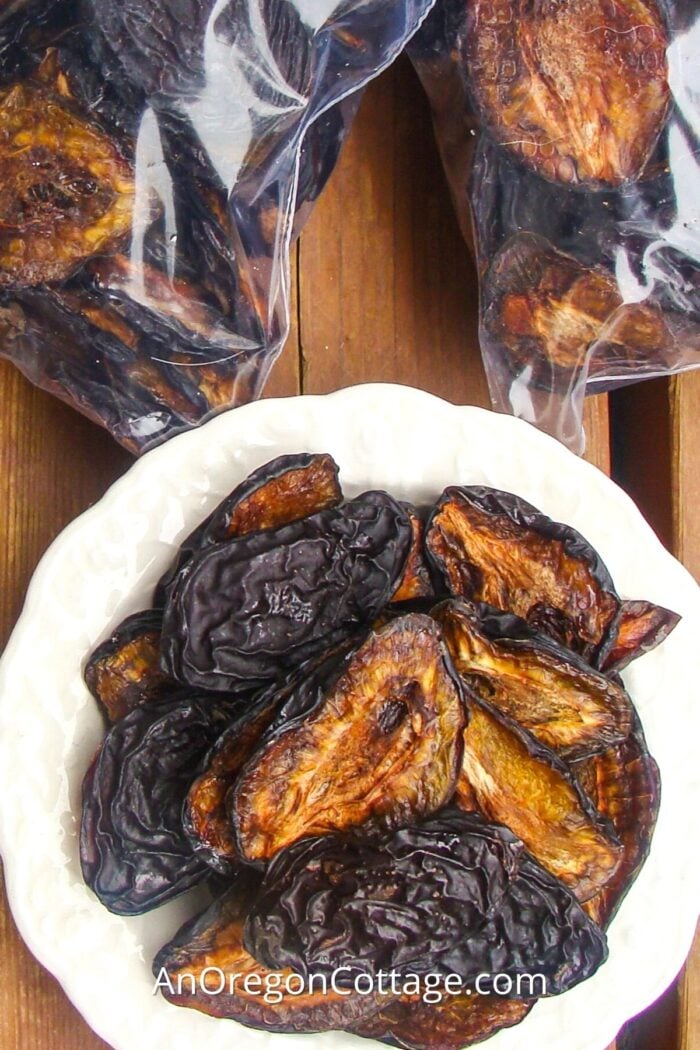
While the dried plums might not look like much, they have a wonderful sweet-tart flavor with a nice chewy (not wet) texture that makes a perfect snack that my kids have loved as much as I do.
Oh, I know what you’re thinking, “Is she talking about prunes?”
Um, not really.
All I can say is that while they are technically prunes, they are also NOT prunes – not the store-bought prunes we all think of.
They don’t have that off-putting wet, squishy texture, smell, or that distinctive prune-like flavor.
Everyone who tastes them agrees, too – these are not like store-bought prunes.
(And I don’t care that the companies who make prunes got together a few years ago and decided to call prunes “dried plums.” The dried plums I make don’t taste anything like their packaged product, so I still call their product prunes!)
The Surprising Health Benefits of Dried Plums
Dried plums are a good source of fiber, antioxidants, and contain psyllium for digestive health, among other things.
But more important than those benefits are the current studies that have shown that eating dried plums daily can have an impact on bone health.
I was so excited when I learned this since I loved them already – well, my version that is!
And if that weren’t enough, there are even a few studies that have indicated that they may even reverse bone loss – which is kind of amazing.
Bring on all the dried plums!

Which plums make the best dried plums?
I think all plums will make a better dried plum at home since you’re able to dry them to reach a firmer product.
But that sweet-tart flavor I love comes from Italian/European “prune” plums which are naturally drier and more tart than traditional round plums (also Damson plums, which are a bit tarter, but we still love).
These plums are an elongated rather than round plum and are usually a purple color.
When you dry these European style plums to a still pliable, yet fully dry, stage they are like small pieces of fruit leather.
Some people may think they look odd (my teenage daughter’s friends would all comment on how they looked – and not in a good way, lol), but they are packed with wonderful flavor.
Drying plums is also one of the easiest preservation methods there is.
I can fill a food dehydrator in about half an hour and then it’s a matter of checking, turning, and bagging the plums as they dry over the next 10 or so hours.
The hands-on time is ridiculously minimal.
How to Dry Plums

Supplies Needed
- Italian/European Style Plums (sometimes called “prune plums”) – though you can use regular plums, too – see FAQ below for more details.
- Cutting Board – I use an over-the-sink cutting board exclusively for this and other preserving tasks as any juice goes into the sink and any pits or seeds are easily moved to a bowl below.
- Sharp Knife
- Electric Dehydrator – I use an Excalibur model that’s no longer available – this is the current 5-tray model (for an oven option, see the FAQ section)

Easy Steps to Dry Plums
1. After washing, slice the plums in half all the way around the pit.
2. Grab each half of a plum and twist gently to separate the halves. Remove and discard the pit.

3. Place halves cut side down on the dehydrator tray.
You can place them cut-side up for less sticking if you want, but I can fit more in my dehydrator with cut sides down. The sides also don’t shrink together with gives me a flatter product that’s easier to store.
It’s OK to pack them close together.

4. Dry according to manufacturer’s recommendations (I use an Excalibur dehydrator which I run at the maximum temperature of 145 degrees).
Depending on the size of the plums, start checking them in 4 to 6 hours, turning trays as needed for even dehydrating.
Once they are looking more dry, flip them over to complete drying (they’ll release from the trays the drier they are – leave them if they are too moist).
Check every 2 hours, removing and packaging up any that are fully dry – showing NO moisture when touched, but are still pliable- and leaving the rest to complete drying.
PRO TIP: If your plums have been drying for only a few hours before it’s bedtime, it’s fine to leave them to dry all night (you can lower the temperature if you aren’t sure). If they’ve been drying most of the day but aren’t done yet, just turn the dryer off for the night, check the plums in the morning, remove any fully dried plums and then continue drying.

Storing Your Dried Plums
When fully dried (see tip below if you’re unsure), pack the plums in glass jars or freezer baggies (using the straw trick to remove as much air as possible).
You have a couple of options on where to store them:
- In a cool damp area at room temperature. I store my baggies in our cupboards and have never had a problem with them molding, probably because we really prefer them on the drier side.
- In the freezer. My brother-in-law (who first introduced me to dried Italian plums) doesn’t dry his as long as I do, so he stores his in the freezer, just to be sure. He will eat them straight from the freezer and then leaves the bag to thaw at room temperature to eat the rest.
TIP: How to Test to See if Fruit is Dry Enough for Room Temperature Storage:
If you’re in doubt as to how dry your plums are, a good test is to package a sample of your dried fruit and leave the jar or baggie on the counter for a day or so – if there is any condensation at all, the fruit was not dried completely.
Then you can choose to dry them more or freeze them for longer storage.
Dried plums will easily last up to a year and maybe more. But to be honest, that just doesn’t happen in our house.
Each year I try to dry more plums than ever in an effort to have them longer than two to four months and we usually eat the last dried plum by May or June at the latest (but that’s only because we’re now empty nesters – when the kids were home we were lucky to keep them until January!).
No matter how we try, it’s hard to eat just one. Or even two…six…whatever. Go ahead and try these – I dare you to eat just one!
Want to save this?
Enter your email below and you’ll get it straight to your inbox. Plus you’ll get easy new recipes, gardening tips & more every week!

How To Dry Plums (Not Your Mother’s Prunes!)
Equipment
- Sharp Knife
- Cutting Board
- Food Dehydrator
Ingredients
- Italian plums (if using another type of plum, the drying time may increase since they are more moist than Italian types)
Instructions
- After washing, slice the plums in half all the way around the pit.
- Grab each half of a plum and twist gently to separate the halves. Remove and discard the pit.
- Place halves cut side down on the dehydrator tray (or cut-side up for less sticking – I can fit more in my dehydrator cut-side down). It's OK to pack them close together.
- Dry according to manufacturer's recommendations.* Depending on the size of the plums, start checking them in 4 to 6 hours, turning trays as needed for even dehydrating. Once they are looking more dry, flip them over to complete drying (they'll release from the trays the drier they are – leave them if they are too moist).
- Check every 2 hours, removing and packaging up any that are fully dry – showing NO moisture when touched, but are still pliable- and leaving the rest to complete drying.
Notes
Nutrition
Dried Plums FAQ
Yes! Though I personally have never dried plums in an oven, a reader let me know that she baked the halves at 180 degrees for 8 hours and they came out nice and chewy. You’ll still need to test doneness, since larger sized plums may take more time, but it’s a good starting point if you don’t have a dehydrator.
Another reader used a used convection oven on the lowest setting (170 degrees F), setting three trays into the oven and rotating them from top to bottom every three hours. He opened the oven door every hour or so to let the steam out and dried the plums halved and pit side up for 10 hours, left them overnight in the oven with it turned off and in the morning reduced everything onto one cooking sheet, set aside the plums that had sufficiently dried from the larger ones that had not, and dried them for another 3 hours until done.
Yes, you can dry regular plums, too. However, they are more moist than the prune-type plums so you will want to cut them thinner and dry them longer. They are typically sweeter, so the flavor isn’t the same, but it’s still a good dried plum option.
No. I think the skins provide a good chewy base for the rest of the plum.
Yes, all plums should be pitted and cut before drying to decrease the amount of time needed to dry this fruit.
You can try that, though it will take longer to dry. When I’ve had plums like that I’ve sliced around the pit, cutting the plum into quarters instead of just in half.
No, I never have and they are perfect.
More Easy Preserving Recipes


This recipe was originally published in 2012, updated in 2018 and again in 2022.
Disclosure: affiliate links in this article will earn commission based on sales, but it doesn’t change your price. Click here to read my full disclaimer and advertising disclosure.


I drying samsusa plums this year let you know how they turn out !
That will be great to know, Jane – thanks!
I am starting out try to learn drying prunes bought fresh fruit since this past sun was their last Sunday selling for this year oh well try to get head start next year like them a lot better than super market stuff any advice for inexpensive method of drying at home thank you
However much you can dry you will enjoy, Richard – they do not compare to store-bought at all. 🙂
We just moved into a house that has an Italian Plum/Prune tree in the courtyard. I just bought my first dehydrator and cannot wait for the games to begin!! Thanks for having a recipe for drying them that is clear and concise. I’m certain my family and I will be in prune heaven soon.
Oh, I’m happy for you – you don’t even have to wait for a baby tree to grow! Enjoy 🙂
I dried mine in an excalibur also. Some have a sticky blob of dried juice right in the middle, about the size of a large pin head. How do I know if they are dry enough?
If the plums are super ripe (maybe a bit over-ripe) they are juicier and sometimes have this. I dry until nothing sticks to my fingers anymore (my fingers may be sticky after touching, but there’s no residue, if that makes any sense…). If the outer edges are getting too crispy, I will remove them, but place them in a separate bag to eat right away. Hope that helps! It’s hard to tell when I can’t see or feel yours. 🙂
Looks delish! Thanks for the recipe, I featured it on my blog: http://www.colorfulcanary.com/2015/10/16-not-so-pruney-ways-to-preserve-plums.html
Do you have to treat the plums with anything like citric acid before drying?
I don’t, Michele and they look just like pictured even after months in storage (if they last that long!).
My plums will not give up the pit. Can I dry them with the pit in and then take the pit out after they have dried?
Oh, I’ve had that clingstone variety before, Paula. Boo. I didn’t try to dry them, though. I think you may be able to, but it will take longer. You’ll have to play around with that. When I had those, I sliced around it and dried the plum in quarters, as an FYI. 🙂
Dear Jami,
I enjoyed reading your article and comments. I miss the real fresh prunes. I wonder if you have few pits or a little tiny prune tree I can purchase from you. I have been in USA over 25 years and never had a prune.
Thanks,
KC
I’m looking forward to trying this with my Santa Rosa plums. It’s a new tree that we planted last year so we’re hoping to get some fruit next year.
Oh, good, Debbie – I hope it works with them as well. 🙂
This is the first time I’ve tried dehydrating and I’ve had plums in my dehydrator for 12 hours now. They are still not dry and I’m tired and want to go to bed! I would like to know where people put their dehydrators while it’s running. My house is so warm right now and it’s a little loud. I didn’t want to put it out in the garage where it’s dirty. thanks!
I keep mine in the laundry room now, but for many years it lived on our kitchen counter when it was being used, Stephanie. They will take longer, but I only leave it to run overnight when I’m just starting the drying process (or just a few hours into it) – I wouldn’t let it run overnight after it’s run for 12 hours, as some of the plums may be too dry in the morning. I like to check and will remove the plums that are dry enough and let the others continue drying – which I can’t do while I’m sleeping. 😉
Thank you! I missed the key point of starting them before bed! Before bed I turned the oven on, transferred the plums to a cookie sheet, put them in the oven, and turned off the oven. This morning they were cool and stuck to the sheet so I turned on the oven to 170 where I’m watching them. Is it safe to let them cool and then try to dry them out again?
Sure, Stephanie, it doesn’t matter if they cool – just start drying again until they are pliable, but no liquid comes from them.
I have a VERY old , small dehydrator Jami- and will be buying a new one soon– saw your reference to the Excalibur…Can you tell me which model you have, and if you’re pleased with it ? Thank you so much !
I actually bought an old Excalibur on ebay that I think is from the 70s – it’s exactly the one I had been borrowing from my mother-in-law (who had the nerve to want it back, ha!), so I was familiar with it. I do have to rotate the trays, as it heats better at the back, but I’m sure the technology is better now. 🙂 I do like the size and the trays – it’s very easy to use and clean up. Hope that helps some!
Thanks Jami ! Will be looking into an Excalibur 🙂
I have 2 yellow plum trees and Italian prune trees.
I just put the yellows in the dehydrator. Very hard to pit them so I just cut the flesh off in 4 directions and do not mess with pitting. I may try to do it with the Italian prunes but they are not as juicy and easier to pit.
I only use the Italian plums, Jack – they dry easier and depending on the variety the pits slip right out. We like them dry and chewy, so the Italian plums produce that kind of result for us. 🙂
hi there –
this is my first summer in Oregon. I just picked 10# of some kind of red-black plum, not a freestone variety, though, and pretty juicy. Was going to dehydrate some, but what do you think, oh you with plum experience – ??
Sounds like a Damson plum, Megan, and they’ll make great dried plums! They’ll be just harder to cut because of the non-freestone pit – you’ll maybe want to try cutting smaller pieces, maybe, to not spend so much time on the preparation!
I have a lot of plums this year and I am grateful to have found your website. I don’t have a dehydrator and so I used my convection oven. The lowest setting I could set it at was 170 degrees F. I set three trays into my oven and rotated the trays from top to bottom every three hours. I opened the oven door every hour or so to let the steam out. I dried the plums halved and pit side up for 10 hours and then left them overnight in the oven with it turned off. This morning I reduced everything onto one cooking sheet and set aside the plums that I thought had sufficiently dried from the larger ones that had not and dried them for another 3 hours. I am happy with the success. I plan to leave them out on the counter for a day and then bag them using the straw technique. Thanks for your advice.
Thanks for letting us know how to do this in an oven, Anthony!
Ok, yeah I found the website from some super famous prune place in Europe that explained how they dry their plums to a certain hydration point, etc. I put mine in the dehydrator last night and the smaller ones are looking mostly dried, so I think I’ll stick them in the freezer for a bit to pasteurize them and then see how it goes! Wish we lived closer, my plum tree went bonkers this year and I have tons! But I got only about 5 plums off the yellow plum tree and I usually make at least 50 pints of jam every year from it so I know how it goes. My apple tree didn’t produce this year either. I guess they’re mad at me for not pruning them. Thanks for responding!
I saw your comment about plums and prunes being different fruits and I can’t find much online that verifies that statement. Pretty much everything I found says that prunes are dried plums. I have an “Italian plum” tree in my backyard and when I researched that years ago, I came to the conclusion that it was the type of plum that prunes are made from. I guess maybe I’m wrong? I did find ONE sentence online that said, “A prune is a particular type of plum that can be sold fresh or dried. Typically, fresh prunes have an easy to remove pit and fresh plums have a hard to remove pit.” The fruit I have in my yard has a pit that’s extremely easy to remove. Does that mean I probably have an actual “prune” tree in my yard? I’ve used them in cakes, made jam from them and this year I’m dehydrating some for the first time. I hope someone has some insight for me, even though I’m leaving this house after 10 years next year (and thereby leaving my prunes/plums too) ! 🙂
I didn’t mean to confuse you, Kimberly – I know that prunes are dried plums, I was simply trying to express that when you dry Italian plums like I outline, they don’t taste anything like the prunes you buy, at all. I don’t know why they don’t – but even when they’re halfway dried (like a store bought prune) they don’t taste like those. It’s weird, actually! But I wanted people to try this even if they don’t like traditional prunes, so that why I emphasized the difference. Have fun with your tree this year – ours didn’t produce very much, so I’m on the hunt for them somewhere else. 🙂
“All prunes are plums but not all plums are prunes.” Plums come in many varieties, some of those varieties are prune plums. They are what makes prunes. (The quotation comes from the Ball preserving cookbook). I have Meyer lemons and they are 2X the size of most lemons, a very thin skin, and while tart, are not anywhere near as tart as the regular supermarket lemon. My point is simply that different varieties have different attributes and flavors.
This is simple a prune is not a prune untel you turn the right type of plums into a prune,
A egg is a egg untel you turn it into a omlet
Thank you, thank you, thank you! You are among the few who recognize that plums and prunes are two different fruits!! My father grew up on a prune ranch (they also grew wine grapes) in northern California, and he would get so mad when he’d hear people say that prunes are plums! They are not!
Glad we agree, Jessica. 🙂
Have you tried this? Utterly delicious… Polish take on dried plums. Insert almond into center of dried plum, coat with melted dark chocolate!!
I don’t have a dehydrator yet, but I was wondering if I could just use my oven
set at that temp. for that same amount of time? Thanks so much for sharing, trying to
build up my storage as fast as I can before winter hits..
I don’t have any experience drying in an oven, Maopa, but I know it can be done. Here is a link I found from someone who tried it with Italian plums that might work for you: http://cookingwithmichele.com/2009/09/dried-plums-and-fruit-leather-by-accident/
Hope that helps 🙂
It’s kind of hard to get low enough tempura with out cooking your fruit ,it can be done , open oven door
A bit and a fan blowing air in, and adjust that untel you get the temperature. Right
I love these! I was so happy to discover them a few years ago. They make great jam too, by the way. Anyhow, I prefer to place them cut side up on the tray – then the tray stays cleaner and there is zero sticking. I think they actually dry faster that way too. Maybe we should do an experiment (every other tray up or down). Or do you already know?
I used to dry them cut side up all the time, but when I did I could only fit three trays in my dehydrator. Otherwise the plums on the lower trays would get pushed all over the place when sliding in the upper tray. I also like how they dry flatter and more uniform when cut side down. But you’re right – there is less sticking. I should’ve mentioned that it doesn’t matter – ’cause it doesn’t. 🙂 Do what works for you!
As for speed, I have no idea! If you run a test, be sure to let us know. 🙂
I prefer cut side up that way the sweet juices are mostly contained and they don’t stick…why waste the juice?