
Homemade Pesto Recipe (with a Secret Frugal Ingredient)
Use the summer’s basil harvest to make this homemade pesto recipe and freeze it in small jars for serving and using in other recipes. It’s super easy, tastes amazing, and uses a special substitute which makes it cheap enough to eat pesto all winter long!
✩ What readers are saying…
If it had 6 stars available I would’ve rated it 6! I’ve made this 3 times now and it has become the most requested thing I make- easy , VERY tasty and never lasts long enough to take up room in the freezer. Will make this the rest of my life— THANK YOU!! -Deb. L

This is the amazing homemade pesto recipe I’ve made for many years with our garden basil, which I make in batches to store in the freezer (we eat it fresh, too, but most of it gets preserved).
It’s like having a great convenience food stashed away to use anytime!
We use this pesto on artisan bread instead of butter (by the way, if you haven’t tried this you really should- but be warned, it can be addicting…), as the sauce on homemade pizza, and in Creamy Pesto Pasta, among other things.
This pesto qualifies as one of my Pantry Basics, right along with ketchup, mayo, salad dressings, etc. – anything we use regularly that we (use to!) think we could only buy from a store.
The pesto is very easy to make, taking a just few minutes to whir together in a food processor. And of course making it at home with your garden basil is less expensive in it’s own right. But that’s not what I mean when I say it includes a frugal ingredient.
The “Secret” Nontraditional Ingredient
This recipe has an secret, nontraditional ingredient that drastically decreases the cost of the most expensive ingredient in most basil pestos: pine nuts.
The secret? Sunflower seeds.
Not walnuts (too strong a flavor) or some other seed or nut I’ve seen mentioned in other recipes, just mild-mannered sunflower seeds. It’s their very neutrality which makes them the perfect substitute, in my book.
But aren’t pine nuts essential? I may be a traditional pesto heretic, but I just can’t justify the expense. And we’re talking three times the cost of sunflower seeds. And I did use pine nuts when I made pesto for the first time years ago – I almost hyperventilated, but I did it to be “authentic.”
And you know what? I couldn’t even taste the pine nuts inside all the garlic, basil and Parmesan. And if we’re going to spend almost $10/lb. for something, we better be able to taste it, right?

Putting Sunflower Seeds to a Taste Test
However, I didn’t really tell anyone (out of embarrassment? shame? guilt? I’ll let you decide…) until the time we had Brian’s cousin and his family to dinner. Now this cousin is an incredible gourmet cook and has made us many memorable meals.
I served pesto with the bread instead of butter (what was I thinking?) and he said, “There’s something different with this pesto- what is it?”
Uh-oh. Gulp. “I…um…used sunflower seeds instead of pine nuts. Can I get anyone more water?”
And get this – he says, “I don’t usually like pesto, but this is really good!”
To say I breathed a sigh of relief is an understatement. So I no longer hold my head down when I say what the secret ingredient is in my pesto. In fact, I think it’s a pretty smart and frugal way to make pesto AND we even like it better!
If you’re more of a connoisseur than I am, by all means, go with the pine nuts. For the rest of us, let’s make a frugal pesto recipe.
Let’s Make Homemade Pesto
Making pesto is so easy!

Step 1: Remove the leaves from the stems and wash them. Dry the leaves – see my tip below for drying and storing in a towel!

Step 2: Gather ingredients. In addition to the basil, you’ll need garlic, parmesan, olive oil, salt – and the sunflower seeds!
TIP: Easily dry basil leaves – and store them for longer, if you need:
- Lay the washed leaves in a layer on a dry tea towel.
- Roll the towel and leaves up to rest and dry while continuing with the recipe.
- OR if you need to break up the pesto tasks into harvesting/prepping and then making the pesto later, you can place this rolled, damp towel in a large baggie, seal it, and place it in the refrigerator. The basil will last for up to a week (though it’s best after about four days)- there may be a few leaves that turn brown, but it keeps them remarkably well.

Step 3: Process the garlic, Parmesan cheese, salt and sunflower seeds in a food processor until finely chopped.

Step 4: Add the basil leaves and process as far as you can (the machine will only partially chop them). Then with the motor running, slowly pour in the extra virgin olive oil.
And voila! Homemade pesto.
How to Freeze Homemade Pesto to Use All Winter

Pesto freezes great and is SO nice to be able to enjoy that taste of summer all winter long!
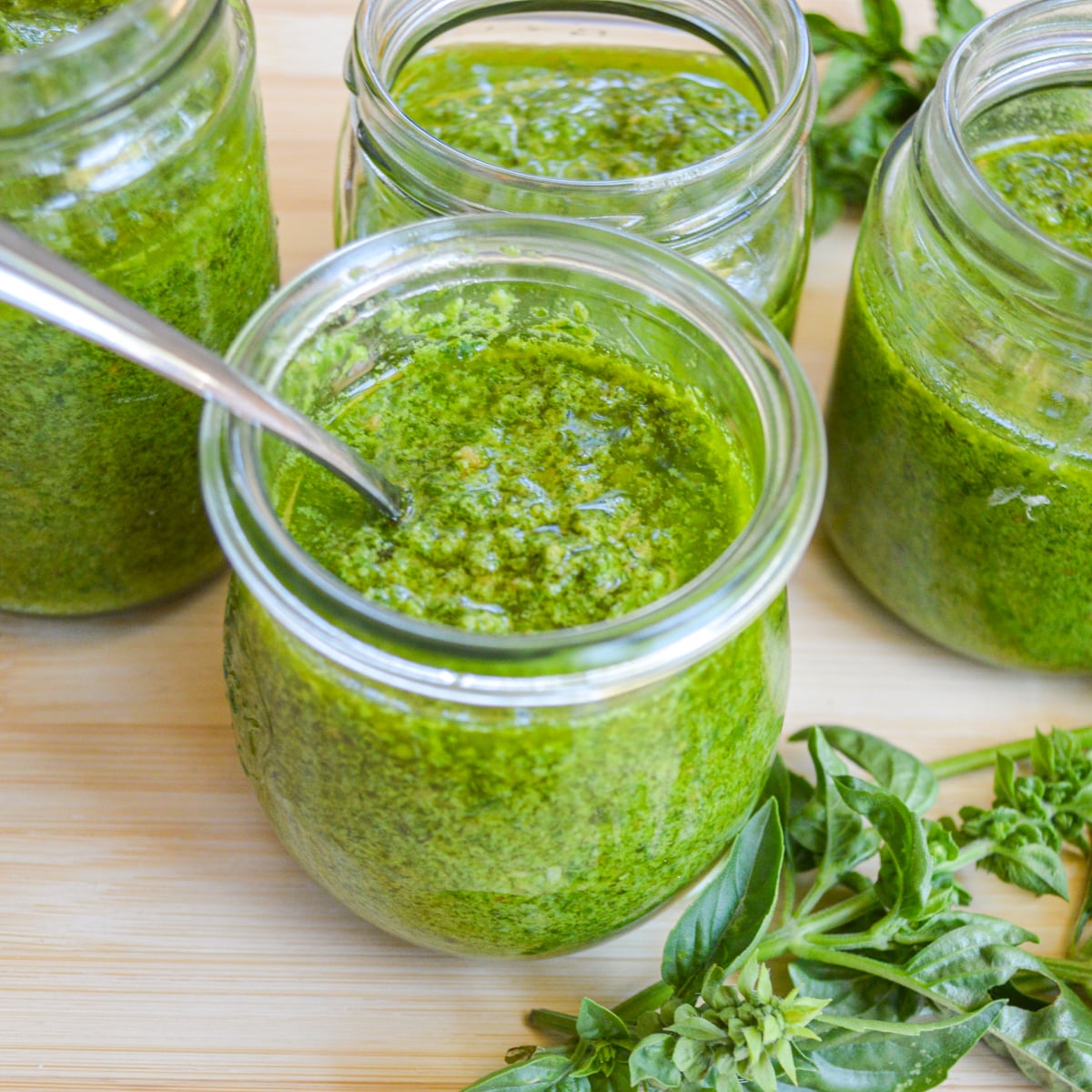
To freeze for later, you simply pour serving-size portions of pesto in containers for the freezer, making sure to leave a 1-2 inch headspace for expansion. I like to add a small layer of olive oil to the top before attaching the lid (see tips below).
What container can I freeze pesto in?
Small glass jars are the most convenient.
You can see in the photo above that I reuse small glass jars from things like marinated artichokes for freezing pesto and I’ve not had a problem with breakage in the many years I’ve been reusing the jars. I like that they’re easy to defrost and then serve directly on the table.
You can also use half pint or 4-ounce mason jars.

Tips for Better Frozen Pesto
Here are two things to do when freezing pesto to enhance the end product (that I learned from The Oregonian’s food section years ago):
- Add a couple teaspoons of lemon juice to each batch of pesto you’ll be freezing- this helps it last longer and stay a brighter green longer after opening (really – when I don’t use it, it turns brown almost right after opening!).
- Cover the pesto in the jars with a thin layer of olive oil which acts like a barrier to keep it fresher. So I actually use a little less oil when processing so I can add this layer that will be stirred in when defrosting and using.
More Pantry Basics Recipes to Try
- Homemade Mayonnaise Recipe – Two Easy Methods
- Quick Honey Sweetened Homemade Ketchup Recipe
- Sweet and Spicy Canned Onion Marmalade
“Was looking for a pesto recipe and came across this one. So glad I did. Just made it today. Really delicious!!” -Sandra M.
“This recipe is dangerously good! I tried it last year and froze most in small jars. The pesto was just as good and colorful when I thawed it this spring as when I made it. I served it at a small dinner party a couple of months ago and it was a big hit. The guests liked it so much they put it on everything but the dessert.” -Marj
If you make this recipe, I’d love to hear in the comments how it turns out! You can also send me a picture on Instagram!
Want to save this?
Enter your email below and you’ll get it straight to your inbox. Plus you’ll get easy new recipes, gardening tips & more every week!

Frugal Homemade Pesto (with Secret Ingredient)
Equipment
- Food Processor
Ingredients
- 6 cloves garlic peeled
- 1/4 cup sunflower seeds*
- 1/2 cup grated Parmesan cheese
- 1 teaspoon salt or to taste
- 2 ½ cups packed basil leaves washed and dried
- 1 tablespoon lemon juice for freezing to keep pesto a brighter green after opening
- 3/4 to 1 cup olive oil plus more if freezing
Instructions
- Pulse garlic in a food processor until minced. Add seeds, cheese, and salt. Pulse a few times to chop, and then add the basil and continue to process until most is chopped (it’s okay if not all is chopped – it will mince as the oil is added). Add lemon juice now, if using.
- With the machine running, add the oil in a fine stream. Process until pesto is smooth. Adjust salt to taste, if needed (less will be needed if using salted sunflower seeds).
- To store in the freezer: pour about a 1/2 cup of pesto into freezer-safe containers, add a shallow layer of olive oil to cover the tops (leaving at least a 1-inch headspace for expansion), attach lids, label with date and freeze.
Notes
Nutrition

This recipe has been updated – it was originally published in 2009, updated in 2015 and 2024.


Sadly, 4 days ago I bought a teeny, tiny jar of pine nuts for around 4 dollars. Now I know the “secret” for next time!
Thanks!
sunflower seeds? Genius! I just about have a heart attack everytime I buy pine nuts (when I can find them that is…). I have tried walnuts and pecans, but both were too strong. My next pesto batch will be made with sunflower seeds.
Brilliant! I’m glad you came out of the closet, er, pantry with your little sunflower seed secret. Wonderful tips ~ thanX so much for sharing this (my wallet thanX you too). I can’t wait to give it a try!