
Easy Canned Tomato Bruschetta – Summer in a Jar
Preserving garden fresh flavor has never been simpler with this tomato bruschetta packed into a jar. Bright, garlicky tomatoes blend with herbs, wine, and balsamic to give you a taste of summer all year long. The recipe preserves the texture of paste tomatoes and you won’t believe the flavor it brings not only to toast, but to salads, pizza, and more all through the winter!
✩ What readers are saying…
“This is the best thing I have ever canned in my decades of canning. Other recipes recommend not peeling, but I think it is essential. I have a dicer and used the 1/2 inch blade which was perfect. The tomatoes stayed firm and tasted fresh.” – Linda

Truth: When I found this recipe for canned tomato bruschetta in a book from the library years ago, I was skeptical. I thought the canned tomatoes would turn out mushy and it would be like putting a chunky sauce on your bread. However I was intrigued enough by the ingredients – wine, vinegar, garlic, herbs – and how easy it was to try it anyway.
And I’m SO glad I did – the tomatoes turned out fabulous with a wonderful texture and deep flavor from marinating in the brine. They make everything from grilled bread to salads to grain bowls and pizza taste that much better.
Honestly, you won’t believe how garden-fresh these tomatoes taste in the winter! It really is like summer in a jar. Now I try to make a couple of batches each season to have on hand when I’m craving tomatoes and the only thing available are wimpy store tomatoes.
What is bruschetta?
But first, let’s talk about what bruschetta is – and isn’t. It’s an Italian appetizer and for many years I thought bruschetta referred to the tomato-garlic-sometimes-onion mixture you top bread with (like this simple and delicious fresh one I make all during tomato season). Then I read that the bruschetta is actually the toasted bread, usually sliced baguette, that’s been rubbed with a piece of garlic and olive oil before toasting or grilling. This can be topped with various things, though it is most commonly topped with tomatoes.
How do you pronounce bruschetta?
For a while I pronounced it like it looks to me: ‘broo-shet-tuh.’ Then I read that ‘ch’ in Italian is always pronounced with a ‘k’ so it should be pronounced ‘broo-sket-tuh.’
Recipe Ingredients
You’ll need the following simple ingredients to make this flavorful tomato bruschetta recipe:

Ingredient Notes
- Tomatoes: The most important thing about this recipe is to use the firm, paste tomatoes in order to ensure they don’t get mushy while canning. This is not the time to use the wonderful Brandywines or other large heirloom tomato, no matter how good the flavor. That said, you can use any type or color of paste tomatoes and you can try your luck with heirloom slicing tomatoes if they are slightly underripe and firm.
- Vinegar: These are basically marinated tomatoes and the vinegar adds both flavor and acid to be able to can the tomatoes without any extra acid needed. The balsamic adds a depth of flavor as well.
- White wine: This is for flavor and to cut the vinegar with a bit of sweetness – it is also an acid, so does add that to the recipe so it can’t just be replaced with water or straight up more vinegar. I have developed a work-around, though for those who don’t use wine in cooking, which you’ll find in the tip below and the recipe card.
- Garlic: As with all canning recipes, do not go over the amount of fresh garlic called for.
- Sugar: You can decrease this as you’d like – it’s there simply to balance the vinegar. You could also use honey.
- Dried herbs: I use basil and oregano, but feel free to use omit one or the other or use other dried herbs you think would be good (I often use a dried Italian seasoning blend along with the basil). You CANNOT use fresh herbs, though – it’s not tested for the addition of low-acid fresh herbs, only for dried herbs.
TIP: Do I have to use wine?
For those of you I’ve heard from who’d like to try this recipe, but don’t want to cook with wine, this is the substitution I’m suggesting after researching the ph of dry white wine and various vinegars (there is some acidity provided by the wine, so you can’t just replace with water):
Replace the 1 cup of dry white wine (ph of 3.0-3.4) with equal amount of apple cider vinegar (ph of around 3). This keeps the acidity about equal, so doesn’t impact the safety. Then use 3 tablespoons sugar or honey to counteract the stronger vinegar flavor.
How to Make Tomato Bruschetta: Step-by-Step
PREPARATION:
- Cut and measure the tomatoes first, so you know how much you have. For this recipe you’ll need to peel them (see my easier method here) and then coarsely chop. I usually remove the juicy-seedy insides, too.
- Have your jars washed and warming (this recipe makes about nine half-pint jars), lids washed, and canner full and ready. You can see my full boiling water canning tutorial here.

Step 1: Combine the all the ingredients except the tomatoes in a large pot to boil and keep warm while packing the jars.

Step 2: Using a slotted spoon, pack the tomatoes into hot jars, leaving a generous 1/2-inch of headspace. I always push the tomatoes down a bit to fit more in each jar.
What is headspace?
Headspace is the amount of space between the food and the top of jar. It’s very important in canning, as it helps with the vacuum sealing, so always follow the recipe’s directions for this measurement (usually 1/4 or 1/2-inch).

Step 3: Ladle the hot vinegar mixture into the jar, covering the tomatoes and being sure to keep the 1/2-inch headspace.

Step 4: Run a wooden chopstick (I no longer use plastic in canning hot foods) around the edge of the jar to remove any air bubbles – poke it in a few places in the center, too. If the liquid settles, add a bit more brine to keep the 1/2-inch headspace.
Why remove air bubbles in preserves like this with chopped produce?
If left as is after pouring, the trapped air can cause the liquid to decrease while canning, which would leave tomatoes exposed and your preserve more open to spoilage.

Step 5: Wipe rim with a damp cloth and attach the lids.

Step 6: Place jars in canner, completely covering them by at least an inch and bring to a boil before setting a timer to process the jars 20 minutes. Turn off heat and remove lid, leaving the jars in the canner for 5 minutes.

Step 7: Remove from canner to a towel-lined counter and cool for 24 hours without touching lids. Check lids for seal and store without the rings in a cool, dark place.

TIP: If you have leftover chopped tomatoes and brine (I usually do) add them all to a jar and keep it in the fridge for 1-2 months (if they last that long!). (Oh, and that’s my canned 3-Bean Salad to the left and it’s GOOD.)

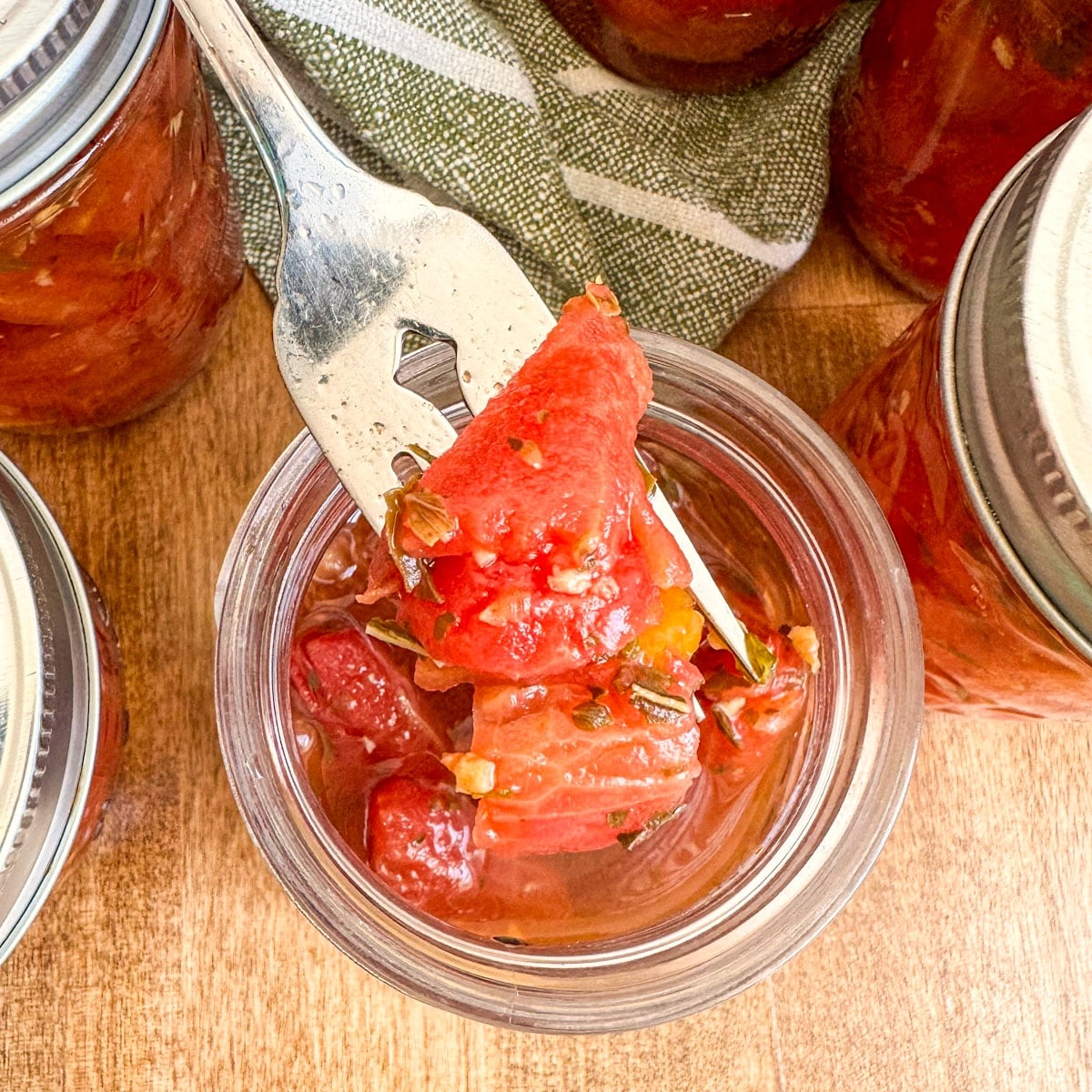
You can see that the tomatoes are firm and not at all mushy! Now all that’s left is to enjoy your “summer in a jar” all winter long!
Storage: Your jars will keep up to 18 months in a cool, dark pantry.

Ways to Use Tomato Bruschetta
- Spoon onto bread slices that have been rubbed with garlic and olive oil and then toasted or grilled.
- Top a cracker that’s been spread with cream cheese or Boursin.
- Toss with tuna, white beans, onions, and olives for a quick salad (a favorite!).
- Add to the top of a green salad or grain bowl.
- Add to any sandwich.
- Use as a topping for pizza, flatbread, or naan.
- Serve alongside eggs, quiche or frittatas.
Reader Raves
“Thank you for this recipe. I made this this year and just can’t quit eating it. The Best!!!!!” -Anita T.
“This was SOOOO good! Thank you for the recipe.” -Lindy H.
I hope you love this canned tomato bruschetta – if you make it, be sure to leave a recipe rating to let me know!
Want to save this?
Enter your email below and you’ll get it straight to your inbox. Plus you’ll get easy new recipes, gardening tips & more every week!

Easy Canned Tomato Bruschetta Recipe
Equipment
- 2 to 3-quart saucepan
- water bath canner and canning equipment
- 9 Half-pint jars and new lids (you can reuse rings)
Ingredients
- 8 cups chopped, cored, peeled plum/paste tomatoes* (about 5 pounds)
- 5 cloves garlic, minced
- 1 cup dry white wine (for alternative, see Notes section below)
- 1 cup apple cider vinegar
- 1/2 cup water
- 2 tablespoons sugar or honey
- 2 tablespoons balsamic vinegar
- 1 tablespoon dried basil**
- 1 tablespoon dried oregano**
Instructions
- Prepare tomatoes, measuring 8 cups chopped.
- Prepare canner, lids, and jars. (See this how-to on water bath canning if needed.)
- In a large, deep, stainless pot, combine all the ingredients except the tomatoes to make the brine. Bring to a full, rolling boil over high heat, stirring often.
- Reduce heat, cover, and boil gently for 5 minutes. Keep warm on lowest heat while filling the jars.
- Pack tomatoes into hot jars with a slotted spoon, leaving a 1/2-inch headspace. Ladle the hot vinegar mixture into jars, making sure to keep the 1/2-inch headspace. Remove air bubbles with a non-metallic spatula (I prefer a wooden chopstick, nothing plastic), adding any additional liquid needed to retain the 1/2-inch headspace. Wipe rims, attach lids and place jars in the prepped canner as you fill each jar.
- Bring water in the canner to a boil and then process for 20 minutes. Turn off heat, remove canner lid and wait 5 minutes before removing the jars to cool on a cloth-lined counter.
- Check seals after 24 hours, then store in a cool, dark place for up to 18 months.
- TIP: Do you have extra brine and/or tomatoes (I usually do)? Add it all to a jar and store in the refrigerator for up to 2 months. Once the tomatoes are gone, use the brine as a base for salad dressing by adding oil (2 parts oil to 1 part brine and 1-2 teaspoons Dijon mustard – so good!).
Notes
- Replace the 1 cup of dry white wine (ph of 3.0-3.4) with an equal amount of apple cider vinegar (ph of around 3). This keeps the acidity about equal, so doesn’t impact the safety.
- Increase the sugar to 3 tablespoons to counteract the stronger vinegar flavor.
Nutrition
Your Questions Answered
Replace the 1 cup of dry white wine (ph of 3.0-3.4) with equal amount of apple cider vinegar (ph of around 3). This keeps the acidity about equal, so doesn’t impact the safety. I would also up the sugar to 3 tablespoons to counteract the stronger vinegar flavor.
ACV is relatively mild compared to white vinegar, so hopefully it won’t make a huge difference in the finished product.
Yes, any tomato can be used though you do want firm, slightly underripe tomatoes that will hold their shape.
No, you can’t add anything fresh outside of what the recipe states since that changes the acid balance. You can always add fresh basil when serving, though.
No, not from a safety standpoint as long as you wash well. However the skins will peel and float after canning and they will be tough. It’s up to you, though – try it without and see what you like.
My initial response would be to say yes, but then I know that the recipe I adapted this from was tested only with 1/2 pints and it’s never safe to go UP in a canning recipe (you can always size down, keeping the processing times the same). So, sadly, no – it is not considered safe to increase the size of the jars to pint. (source).
More Tomato Preserving Recipes To Try
- How to Dry Tomatoes And Store In Olive Oil
- Home Canned Pizza Sauce (From Frozen or Fresh Tomatoes)
- Canned Tomatoes & Chilies – Rotel Copycat Recipe
- Addictive Tomato Chutney: Updated With Less Sugar

This recipe has been updated – it was originally published September 2009.


Made this today Jami, 10 little jars of summer loveliness. I’m sure we will love it! My family loves all the things I’ve made from your recipes over the years I have been following you. I’ll keep you posted ❤️
Oh, yay! Hope you guys enjoy those summer jars, Julie 💜
I don’t like the taste of vinegar in canned tomato products.
Can I just add citric acid instead to each jar? LIke maybe 1/2t/citric acid per 1/2 pint jar?
Thanks!
No, this is a pickled product and the recipe must be followed as written. Without the vinegar it’s diced tomatoes with seasonings, so I’d find a diced tomato recipe to use that you can use citric acid with (though without the pickling, you usually have to process longer, so the tomatoes wouldn’t be as firm).
I was wondering if I can make this in pints? We go through the 1/2 pints too fast.
Ugh, Linda – my initial response would be to say yes, but then I know that the recipe I adapted this from was tested only with 1/2 pints and it’s never safe to go UP in a canning recipe (you can always size down, keeping the processing times the same). So, sadly, no – it is not considered safe to increase the size of the jars to pint. (see: https://extension.sdstate.edu/modifying-canning-recipes)
This is awesome. Other servings suggestions:
Using a slotted spoon, use to top pizza, prepared flat bead, naan, quiche, salads. Anything that can use a boost from fresh tasting tomatoes. It is truly summer in a jar. I am making another double batch tomorrow.
Pro tip: I save the left over “juice” and add to soups and any recipe that can use a flavor boost.
LOVE this, Linda – so glad you’re enjoying this deliciousness in so many ways! And a big YES to using the leftover juice, it’s so flavorful. 🙂
This is the best thing I have ever canned in my decades of canning. Other recipes recommend not peeling, but I think it is essential. I have a dicer and used the 1/2 inch blade which was perfect. The tomatoes stayed firm and tasted fresh. I am making the addictive tomato chutney next. I wish I could post a picture.
Oh, I LOVE this review Linda – thank you SO much! I’m glad to know that the dicer worked, too, as I’ve recently added one to our kitchen and will try this next (and so agree with the peeling part being essential!).
Hope you enjoy the chutney as much as we do, too!
I added all my tomatoes to the vinegar mix and then ladeled into jars because I felt like I wasn’t getting enough vinegar mix in compared to tomato juice.
Do you think they will be alright?
I also added 1/4 tsp of citric acid to each half pint.
Yes, with the vinegar and the citric acid the jars will be safe!