
Easy Sourdough Artisan Bread Recipe (Ready in 1 Day)
If you’ve been looking to bake a crusty, golden loaf of sourdough without the complexity of typical recipes then this easy sourdough artisan bread recipe is for you! Designed for simplicity, this method uses everyday measurements, minimal steps, and a stand mixer (or hand-kneading) to create a dough that’s ready to bake in just one day. Baked in an enameled cast iron pot (with other options), the result is a beautifully blistered crust with a soft, chewy interior — perfect for both beginners and seasoned bakers seeking a reliable, no-fuss loaf.
✩ What readers are saying…
“I wish I could say how great this recipe is in words!… Could this be true? Could I have found the perfect sourdough recipe for me and my family? After all these years and all these attempts, suddenly, in my lap, the sourdough recipe that really IS “The Easiest Best Sourdough Recipe on Earth”? Really? Well, I’m here to tell you, “YES!” Emphatically, “YES!” This is it! So good! So easy! So perfect! Please try this recipe! You will be so happy you did.” -David

Some links in this article are affiliate links and if you click on them I will receive a small commission at no cost to you.
Ever since I grew my first sourdough starter and explored how to make sourdough bread, I’ve wanted to be able to make a really good loaf of artisan sourdough bread like my favorite regular yeast easy artisan bread.
I was looking for an easy sourdough bread recipe that had a crispy crust with a nice texture and holes inside, but that was simple to make. Preferably a same day sourdough bread similar to my super easy artisan bread which bakes in an enameled cast iron pot.
What I mean by ‘easy’ is a basic everyday kind of sourdough bread recipe that uses cups to measure, few steps, and very little science involved, sort of like our great-grandmothers would’ve made.
If you’d like to get really into sourdough – which can quickly become complicated (and frankly, overwhelming to me), I’ve found Northwest Sourdough to be very thorough and not too hard to follow for those wanting to dig a little deeper.
I searched for a couple years to find a technique that would produce a loaf of artisan sourdough bread that was all the things I wanted.
When I found this great recipe I knew right away that I could adapt it to be even easier, use my favorite enameled cast iron pot, and consistently turn out good loaves.
And it did! This is truly the easiest sourdough bread recipe that anyone can make, from beginners to seasoned bread bakers. It can be made quickly (well, in sourdough terms) in one day or you can choose a bulk fermentation overnight in a refrigerator.
I want to say, too, that for me an easy bread is always made with a stand mixer, but this recipe can be made by hand – you will just have to work a bit harder.
Artisan Sourdough Bread Recipe Video
Ingredient Notes

You need only 3-4 ingredients for this classic bread – here are some notes and answers to questions I’ve gotten about the ingredients:
- Flour: You can make this bread with all-purpose, white whole wheat, spelt, or whole wheat flours. Spelt and whole wheat will have a denser crumb and less holes. You may get a taller rise by using bread flour, either white or whole wheat, which contains more protein (higher protein content in flour is needed for gluten development). Note: Pastry flours have less protein, which makes them great for cookies, muffins, and quick breads, but not for yeast or sourdough (wild yeast) breads.
In these photos I have used all white whole wheat flour with my regular whole wheat starter so the bread isn’t as white as loaves made with white flour. I also share a loaf made with regular whole wheat below. I always use a whole wheat starter and typically mix and match the flours I have on hand.
- Sourdough starter: I created my starter using these easy steps with whole wheat flour. Your starter should be strong for this recipe – very bubbly and doubling in volume after feeding in 6 hours or less (see the Important Note below). I like to feed the starter the night before (see timeline below).
- Salt: This is the third ingredient you must include in the recipe (in addition to water) or your bread will be very tasteless. After making this one time, feel free to adjust the salt to your preferences.
- Honey: I’ve made this ingredient optional, but I always use it. It adds a bit of immediate sugars for the yeasts to feed on as well as helping the crust to brown.
Sourdough Artisan Bread Step-by-Step Instructions

Step 1. Add all the ingredients (flour, water, starter, optional honey, and salt) to a bowl and mix dough just until combined. Let sit for 15 minutes. If using a mixer and dough hook, knead for 5 minutes. If making by hand, knead for 8 to 10 minutes.

Step 2. As you’re kneading, add more flour as needed, a little at a time, to create a dough that’s still clinging to the bottom of the bowl, but clearing the upper part of the bowl. It should be tacky, but not cling to your finger other than a bit of residue as shown.
TIP: If you’d like to add dried or fresh herbs or any other mix-ins, add them during this kneading portion. Wait until you’ve got the dough to the stage you see in step 2 and then mix them in before scraping into the bowl.

Step 3: Transfer to a large bowl, lightly coated with oil. The dough should stick to the bottom and need to be scraped out.

Step 4: Cover with plastic wrap or a damp towel and let the dough rest for 3 hours.
TIP: I use plastic “shower cap” type bowl covers which I wash and reuse over and over – I’ve had many of them for years. I’ve found plastic keeps the dough more moist over the long rise than a damp towel. Update: I’ve recently been moving away from plastic in the kitchen and have found that beeswax bowl covers do a nice job of keeping the dough moist while rising.

Step 5: During the 3 hour rise, turn and fold the dough once or twice by bringing all the edges of the dough to the center.

Step 6: Remove dough, turn and fold again, and place it back in the bowl, seam-side up. Let rise for another 2 hours.
TIP: I do this right over the bowl with my hands oiled from the dough, which is usually enough – add more oil to your hands if needed. This is described in detail in the video.

Step 7: After the second rise, place a piece of parchment paper on a cookie sheet or small skillet (see tip below), sprinkle the dough with flour and gently shape the dough into a ball or oval right over the bowl (using lots of flour, as the dough is moist) and set on the parchment. Make sure there’s a good coating of flour on the top, as this will make slicing the top later easier. Replace the cover for the final rise.

Step 8: While the shaped dough is resting at room temperature, set an empty 4-6 quart enameled cast iron (or regular cast iron) dutch oven into a cold oven and turn heat to 450 degrees (alternately, you can use a baking stone), and set the timer for 40 minutes. (See FAQs below for cooking without a dutch oven.)
TIP 1: I flour my fingers after setting on the parchment and then use them to push the edges under the loaf to get the shape I want, make it more compact, and create more surface tension. See video for more details.
TIP 2: Shape the dough into a small skillet to keep the edges from spreading as much as a cookie sheet. If you have a bread proofing basket, feel free to use that.

Step 9: When the timer goes off, slash the top of the loaf with a serrated knife in 2-3 places making whatever pattern you’d like. If you have a lame, you can use that to make more intricate patterns.

Step 10: Transfer the slashed loaf to the hot pot (or stone) by holding the edges of the parchment to gently lower into the pot (the bread will bake while on the parchment).

Step 11: Replace the hot lid and bake for 12-15 minutes. Remove the lid and continue baking for another 13-15 minutes, until golden brown and internal temperature reads 190 to 200 degrees with an instant read thermometer.
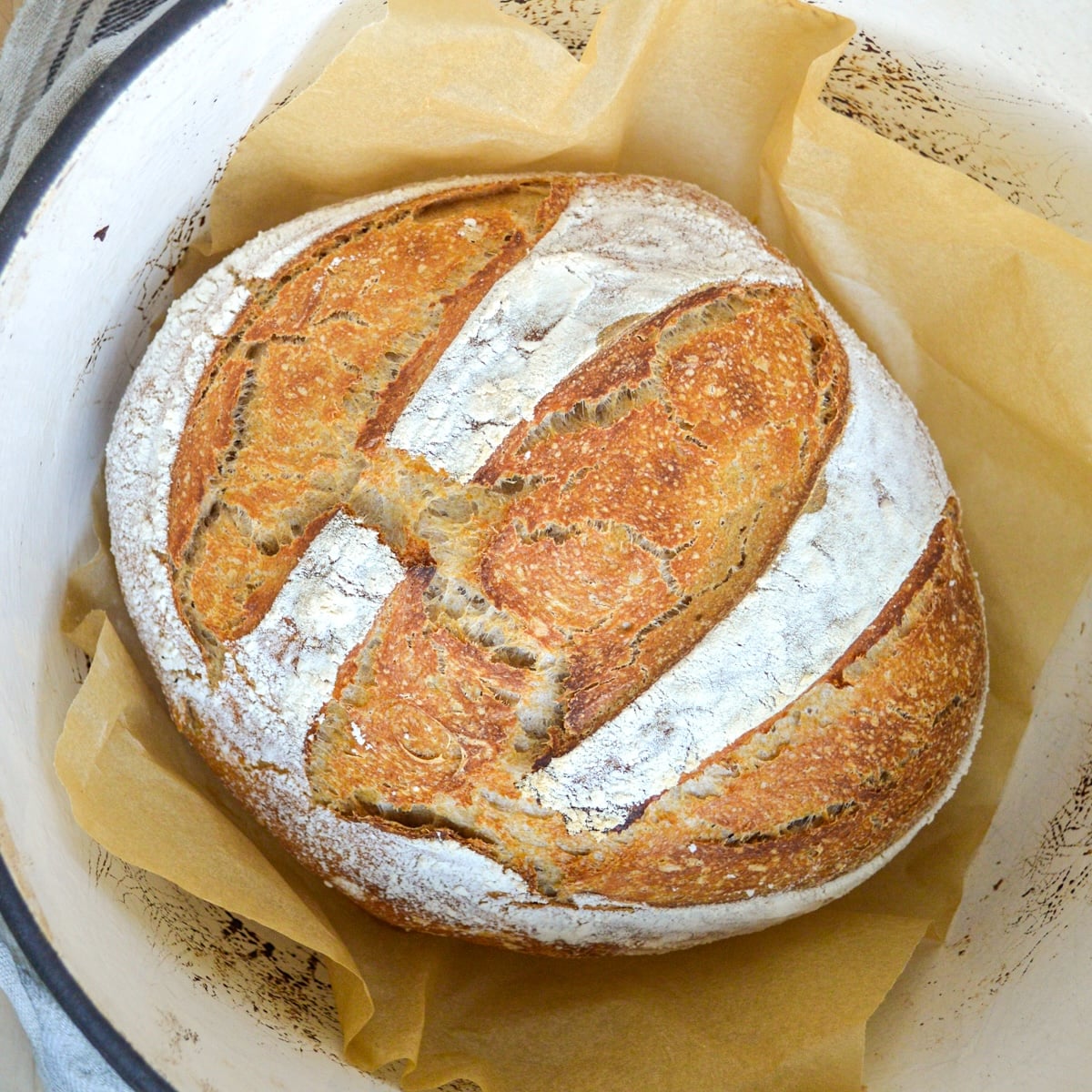
Look at that crust! That’s bread-beauty right there, isn’t it? Blistered and cracked and bubbly. You can see why I think this easy sourdough bread recipe is the best!
What about using all whole wheat flour?

The sliced loaf pictured above was made with whole wheat bread flour (verses the previous loaf pictures made with whole wheat white flour), so the crust isn’t quite the same, but still passes the test.
And the interior is a bit more dense, but still full of holes, chewy, and with just a touch of sourness. Perfection. (Note: When made with all regular whole wheat flour there will be only tiny holes in the crumb, making it more dense than this – but it’s still good in my opinion.)
Since sourdough starter is best when it’s used weekly or every two weeks, I now make this sourdough bread recipe more than my favorite easy artisan bread. But either is a winner recipe, in my book.
Important Note on Using Starter to Make Bread
I have gotten many comments on this recipe along the lines of, “great flavor, but it was so flat,” or “I let it rise all day and it didn’t double.” Here’s what I’ve learned on my sourdough journey:
You cannot make bread rise well with a new starter. It needs time to grow and strengthen to be able to rise bread.
You may be able to rush it if you’re doing a lot of feedings, but it may take weeks or up to a month for the starter to be strong enough to raise bread.
How do you know if a starter is strong enough to raise bread?
Here’s the test I use and find the easiest:
If your starter doubles in less than 6 hours, it is strong enough to raise bread.
If you don’t have a way to measure, use a piece of tape on the outside of your container – anything that allows you to see if it’s doubled. When it’s doubled, you can confidently use this recipe! (
What about using the float test? I find that when working with whole grains the float test (seeing if a piece of your starter floats in water) isn’t as good a guideline as doubling.
What do I do with all the starter I’m making, feeding, and removing while waiting for it to be strong enough to double?
You can make recipes that don’t rely on the wild yeast in sourdough to completely raise it! Lovely baked goods like:
- Whole Wheat Sourdough Crackers
- Sourdough English Muffins
- Sourdough Waffles
- Sourdough Cheese Batter Bread (use this when you’re this close to making bread – the batter doesn’t need to rise as much, but still gives a nice bread).
For even more unique and delicious ways to use your sourdough discard, check out this amazing list of 35 sourdough discard recipes!
Shop This Easy Sourdough Bread Recipe
- This is a great quality, decently priced enameled cast iron dutch oven, similar to the one I use. Here’s another option for a bit less that’s very similar, too.
- I’ve used Kitchenaid mixers for years to make all my breads – this is the current version of the one I’m using now.
- Here’s a rising bucket that holds a lot and is easy to see when your starter is doubling. Personally, though, I use my glass 2-quart measuring cup with a lid instead of plastic.
- This is my favorite brand of white whole wheat flour (made from hard white wheat).
- And I use this brand for hard red wheat flour (‘regular’ whole wheat). My starter is fed with this.
Timing For Same Day Sourdough Bread
The timing of sourdough bread was hard for me to figure out in the beginning, since it takes longer to rise than regular yeast breads, so I thought I’d share the typical timeline needed to serve a loaf of artisan bread for dinner.
To have this sourdough artisan bread ready for an evening dinner:
- Feed your sourdough starter the night before you want to bake.
- Start the sourdough artisan bread recipe the next morning.
- Let the dough rise until early afternoon before baking and cooling in time for dinner.
Forgot to feed your starter? It happens to the best of us! If you find yourself in that situation, you can feed the starter right when you get up in the morning and let it sit until it is bubbly, usually a couple of hours, and then proceed with the recipe.
Made this way, the bread doesn’t have quite the optimum time to cool, so you’ll have a warmer loaf with a bit more squished crumb – but we’ve sure never minded.
Sourdough Artisan Bread FAQs
Yes, the second rise can happen in the fridge. Let the dough come to room temperature for about an hour before you start to shape and heat the pot.
You will have the best results with a dutch oven or some type of pot with a heavy lid. But if you don’t have one, here’s what you can do:
-After shaping the loaf on the parchment on the counter (or in a small skillet), place either a baking stone, cast iron skillet, or cookie sheet into a cold oven and preheat to 450 degrees.
–Creating Steam: To try and get the crust we all love, you’ll need to create some steam (that’s what the dutch oven does – it traps the steam): put a pan with water on the bottom rack to heat while the stone heats OR spray the dough with water right before putting in the hot oven to bake and see which you like best. Also, if you have any deep lid that will fit over the dough and allow to rise, you can add that OR try tenting aluminum foil over the top.
–Baking: Slash and use parchment corners to transfer dough to your hot stone and bake 15 minutes, turning the dough halfway, and then bake until done, another 15 to 20-25 minutes.
These add-ins can be kneaded into the dough at step 2, after the first step of letting the dough sit for 15 minutes.
A Few of The Many Reader Raves
“Wanted to tell you your sourdough recipe was the best and easiest! It tasted great and I felt like I accomplished my dream of finally making sourdough!” -Stephanie
“Here’s another thank you for the simple recipe. I have been been struggling to find one that want so overwhelming; I don’t want to understand every minute detail of science….I just wanna bake some bread! This is the only recipe that I’ve had success with.” -Brittney
“Since I am new to sourdough, I was skeptical that this would work on my first try. It turned out fantastic.” -Helen
“Thank you for this awesome video! A friend gave me a jar of starter over a month ago and I was hesitant and unsure of how to proceed after watching other videos online. I made my first loaf ever last night and it was incredible. I really appreciate your video, it’s like you’re in my kitchen helping me along the way. All of your tips were super helpful and I now love making bread!” -Tracy
I hope you love this sourdough artisan bread as much as we do – if you make it, be sure to leave a recipe rating to let me know!
Want to save this?
Enter your email below and you’ll get it straight to your inbox. Plus you’ll get easy new recipes, gardening tips & more every week!

Easy Sourdough Artisan Bread Recipe
Equipment
- stand mixer or hand kneading
- 4-6 qt cast iron pot or baking stone/cookie sheet with steam bath
Ingredients
- 3+ cups (360-400 g) flour white whole wheat, whole wheat, unbleached, or a combo
- 1 ¼ cups (300 g) warm water*
- 3/4 cup (150 g) active sourdough starter 75%-100% hydration (I prefer 80-90%)
- 1 tablespoon (21 g) honey**
- 1 ½ teaspoons (9 g) salt or to taste
Instructions
- Mix all ingredients together in the bowl of a stand mixer (or large mixing bowl) just until combined and then let sit for 15 minutes.
- Using a dough hook, knead for 5 minutes. If making by hand, knead for 8 to 10 minutes. (TIP: You may add more flour as needed, a little at a time, to create a dough that's still clinging to the bottom of the bowl, but also clearing the upper part of the bowl. It should be tacky, but not cling to your finger.)
- Transfer to a medium-sized bowl, lightly coated with oil. Cover with plastic or a damp towel and let rise for 3 hours, turning and folding the dough once or twice.
- Remove dough, turn and fold again with oiled hands, and place it back in the bowl, seam-side up. Let rise for another 2 hours. TIP: I do this right over the bowl with my hands oiled from the dough, which is usually enough – add more oil to your hands if needed.
- After the second rise, place a square of parchment paper on a cookie sheet, sprinkle the dough with flour and gently shape the dough into a ball or oval (using lots of flour, as the dough is moist) and set on the parchment. Shape it in your hands right over the parchment. I often flour my fingers after setting on the parchment and use my fingers to push the edges under the loaf to get the shape I want and make it more compact. Make sure there's a good coating of flour on the top, as this will make slicing the top later easier. TIP: I often shape the dough in a small skillet to keep the edges from spreading as much as a cookie sheet.
- To Bake with a Dutch Oven: While the shaped dough is resting, set an empty enameled cast iron (or regular cast iron) dutch oven into a cold oven and turn heat to 450 degrees (alternately, you can use a baking stone), and set the timer for 40 minutes.
- When the timer goes off, slash the top of the loaf with a serrated knife (in 2-3 places) and transfer it to the hot pot (or stone) by holding the edges of the parchment to gently lower into the pot (the bread will bake while on the parchment).
- Replace the hot lid and bake for 12-15 minutes. Remove the lid and continue baking for another 13-15 minutes, until golden brown.
- To Bake without a Dutch Oven: After shaping the loaf on the parchment on the counter (or skillet), place either a baking stone, cast iron skillet, or cookie sheet into a cold oven and preheat to 450 degrees.Creating Steam: To try and get the crust we all love, you'll need to create some steam (that's what the dutch oven does – it traps the steam): put a pan with water on the bottom rack to heat while the stone heats OR spray the dough with water right before putting in the hot oven to bake and see which you like best. Also, if you have any deep lid that will fit over the dough and allow to rise, you can add that OR try tenting aluminum foil over the top.Baking: Slash and use parchment corners to transfer dough to your hot stone and bake 15 minutes, turning the dough halfway, and then bake until done, another 15 to 20-25 minutes.
- Remove to a wire rack to cool at least 30 minutes before cutting.
Notes
Nutrition
More Sourdough Recipes to Use Your Starter
Find recipes like no-knead sourdough focaccia, sourdough lemon loaf, soft sourdough bagels and much more on the sourdough recipes page here.

This recipe was originally published in 2012 – it’s been updated as recently as 2025.
Disclosure: affiliate links in this article will earn commission based on sales, but it doesn’t change your price. Click here to read our full disclaimer and advertising disclosure.

Hi Jami,
I am not familiar with making sourdough bread, when we feed sourdough the night before. Do I leave at room temperature or in the fridge?
Yes, when feeding the sourdough should be at room temperature. The fridge is just for storing when not cooking with it.
You might find this article helpful: How to Grow, Use & Keep Sourdough Starter.
I used this recipe yesterday. I wanted to compare results with the very complex and long version of making this bread- taking about two days. I liked your bread just as well as the longer version, so will use it in the future. Made two changes- waiting an hour before I added the salt. I’ve read several god reasons to delay the salt. Then I realized that I had forgotten how much flour I had already added and had to guess how much more to add. I bake lots of regular bread and generally don’t measure the flour, but know the amount matters s lot more in sourdough. I realized the dough should be wetter. It turned out fine, but I will definitely not make that mistake again. But, your recipe still won! I didn’t need to measure 15
Grams of anything! Yay.
I’ve found that to be true, too, Jennifer – that’s why I tested an easier version. 🙂
Glad you like it!!
Hello! Wow this recipe is incredible. I’m only on my second loaf so far and don’t plan on stopping. I was wondering what the bake time would be if I made two smaller loaves? Thanks so much!
Just cooking on baking sheets at the same time or one at a time in the dutch oven?
Well, either way, it would be less baking, for sure. I’d try 10 minutes less and then see if they were done. You can tap the bottom for a hollow sound or use an instant read thermometer to get to 205 degrees.
My bread came out great except not very crusty
I was expecting more of a crunchy texture ?
I did use a Dutch oven
What could have made not so crusty?
Followed all other directions carefully
Not sure, Pat. You can remove it from the pan and put in on a cookie sheet and broil the top for a minute or two to get a crust you like (I have quite a few people tell me they don’t like it crusty and how to get it softer, lol).
Since I am new to sourdough, I was skeptical that this would work on my first try. It turned out fantastic. I was looking for a recipe that was crusty and didn’t use additional yeast in the bread recipe. I tried a recipe with added yeast and didn’t care for it. I don’t know if it was beginners luck with this recipe but I definitely plan on making again and again. Thank you.
Yay – you’re so welcome, Helen! I’m with you on the yeast – the whole purpose of sourdough is to not use yeast, lol.
Here’s another thank you for the simple recipe. I have been been struggling to find one that want so overwhelming; I don’t want to understand every minute detail of science….I just wanna bake some bread! This is the only recipe that I’ve had success with. My bread rises beautifully and comes out looking lovely. However, the texture is consistently dense and rather gummy/doughy. I am trying to hard for a nice open crumb but I cannot seem to figure it out. Any ideas?
Is this even after it’s completely cooled, Brittney? If you cut a bread while it’s warm from the oven, the texture is often gummy. Other than that, you’ll want to make sure the dough isn’t too wet OR too dry – find a good balance of a wetter dough, but still able to be shaped with floured hands. Also be very gentle with the dough when shaping to avoid releasing the gas that has built up.
Hope these things help!
I am new to this , How do you make a starter?
You’ll need to grow a starter for a week and then use it for things that don’t need as much rise as you are building a stronger starter (like crackers, english muffins, waffles, etc.). I have a guide with all the details here: How to Grow, Use, and Keep a Sourdough Starter.
Have fun!
Does this work with Self-Raising flour or plain flour instead of white whole wheat?
No, you wouldn’t want to use self-rising flour (it has a leavening agent, baking powder, added), but you can use regular white flour in this recipe.
How do you get good color on your bread? I’m following the recipe and the bread is done but not nearly as brown and crispy as yours
Hmm, I’ve never had a problem with it browning, Morgan, once I take the lid off for the second half of cooking. Wondering if it’s your oven or something?
You can place it on a cookie sheet and place it back in a hot oven on a top-most rack to see if it will brown, or even broil it for a few seconds/minutes (keeping an eye on it). Just some thoughts, since I haven’t dealt with this.
Can I use a 9×5 inch bread on? I don’t have a Dutch oven or baking stone.
No, those are for sandwich breads. You can bake this on a preheated cookie sheet, shaping on the parchment and then using the corners of the parchment to transfer it to the hot cookie sheet. To try and get the nice crust, you can place a pan of water on the bottom rack while it’s preheating, then cook with it in there (or spritz the loaf with water right before putting in the oven).
How soon can I bake with my new starter. It’s only 6days old but has doubled in size after every feed the last two days.
Is it doubling in 6 hours or less? My recommendation is to err on the side of caution and make other things with it that don’t need as much strength to rise (because as you’re doing this, you’re removing starter and refeeding, which just makes it stronger).
BUT, I have heard from quite a few people that they did make this with a new starter and it did turn out!
So, if it’s really doubling in that amount of time, you can go for it if you want!
Can you use all purpose white flour to make the dough?
Yes.
Thank you for writing an easy to follow, uncomplicated recipe. Other recipes make it seem like you need 2 days to make a good loaf of bread using sourdough starter! Your recipe is perfect for beginners. My 1st time making bread using my starter turned out beautifully & tasted absolutely delicious. You are a genius & you’ve made dealing with this pandemic a lot easier! Thank you!
Oh, how sweet – thank you so much Inez, you just made my day!
Appreciate the review, too, and so glad you were able to experience a good loaf of sourdough. 🙂
Hi,
How would I adapt this to make without a Dutch oven?
Thanks!
You can make it on a baking stone or even a simple cooking sheet, the crust will just be a bit different. To create steam, either mist the loaf right before baking or set a pan on a bottom rack full of water to heat while the oven heats.
Hi! Do you leave the pan with water in the oven while the bread is baking as well as while its pre-heating?
Thank you
Yes!
I am new to sourdough. Do you use a dry or liquid measure when adding the starter in the first step?
I’ve used both, Liliana, and it seems to be fine either way. With starter I’ve found it doesn’t need to be exact – I usually err on the side of a little more. Everyone’s starter is a bit different, so it’s at the flour stage you’ll have to adjust to get the right consistency (not too wet, but not too dry – wetter is better for artisan bread, but you still need to be able to shape it).
Hope that makes sense!
After the first rise, how do i remove it? Put it on a board with flour and fold it?
I just shape it in my floured hands, set it on the parchment, and continue shaping as needed on the parchment to get a nice ball.
I’m sorry. I mean after the 3 hour rise and before the two hour rise
Oh, oops! Okay, yes you can dump it to a floured surface. It’s just a way to get another good fold in it – just treat it gently to try and keep the gasses that’ve developed in.
I have a baking stone and I also have a cast iron Dutch oven, so I could use either. When using the baking stone, do you have to cover the bread while baking? Question 2. Do you use yeast in your sourdough bread? I’ve seen recipes both with and without yeast. I used a different recipe for my first attempt at sour dough and it had a great flavor but it didn’t rise well. I look forward to trying this recipe, but my preference would be to use the stone.
You’ll get better results on the crust, I believe, with the dutch oven. That said, test it out for yourself to see which you prefer! When using a stone, you’ll want to do something to try and create some steam at the beginning -either cover with a big roasting pan lid, placing a pan of water in the lower rack to heat with the stone, or even spritzing some water on the loaf right before placing in the oven.
I never use yeast in sourdough. The whole point of sourdough is not to use commercial yeast, in my opinion. Plus, baking with wild yeast has been around forever. You can most definitely get a good rise with a strong sourdough starter. The key I’ve found is when your starter doubles within 6 hours after feeding and then making your bread at that point.
Let me know how it goes!
So easy and way less time consuming than other recipes! Thank you.
You’re welcome, I’m glad you think so! Thanks so much for the review.
After the 1st rise how do I turn it out? With flour or with oil?
I use well floured hands, shape and set on the parchment to finish shaping with more flour.
Have used this recipe 3x’s since quarantine..
Every time amazing! Thanks!!!
Yay!! Thank you so much for the review.